Why Does the Moon Have Phases?
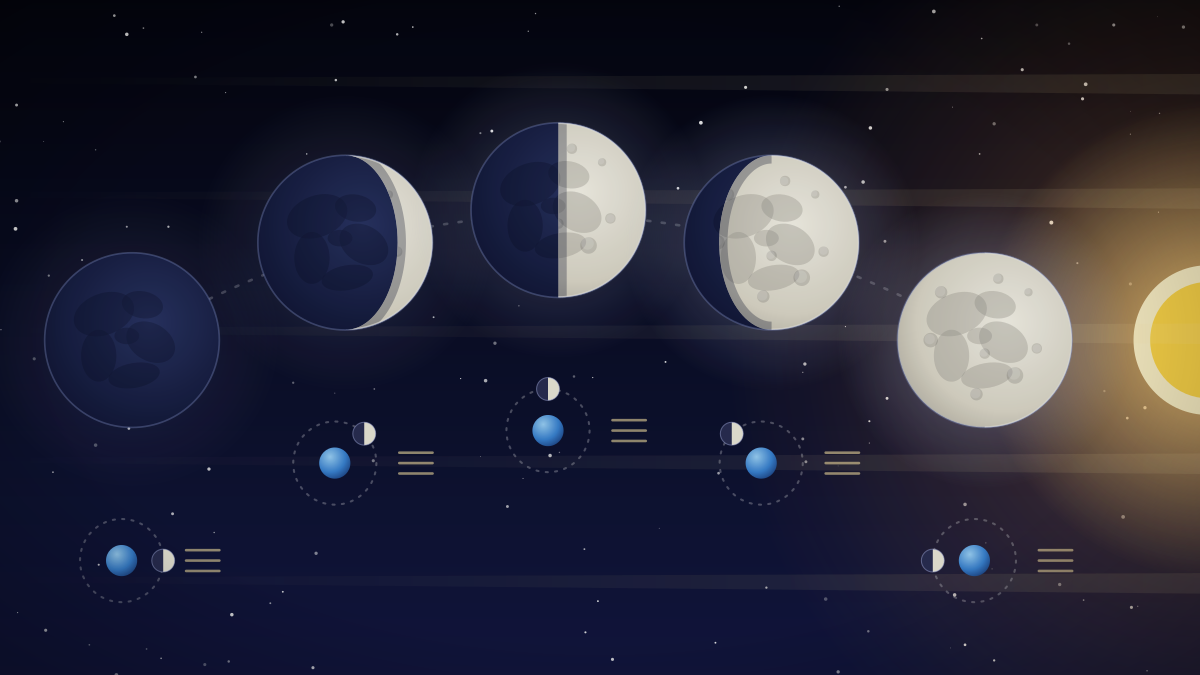
- The Sun always lights half of the Moon; phases are the changing share of that lit half visible from Earth.
- The phase cycle takes about 29.5 days, while one orbit takes about 27.3 days.
- The same side of the Moon always faces Earth because of tidal locking.
Reflected sunlight, always half lit
The Sun is the only object in the solar system that makes its own light, so moonlight is reflected sunlight.[1] At any moment the Sun lights half of the Moon, just as it lights half of Earth. Phases arise because the Moon orbits Earth, and the portion of the lit half that faces Earth changes from night to night.[1]
At new Moon, the lit half faces away from Earth and the Moon is not visible in the daytime sky because its unlit side faces Earth, even though it rises and sets with the Sun.[1] At full Moon, the lit half faces Earth. In between, a growing or shrinking slice of the lit half is turned toward Earth.
The eight phases in order
NASA lists the phases of one cycle as follows.[1]
- New Moon
- Waxing crescent
- First quarter
- Waxing gibbous
- Full Moon
- Waning gibbous
- Third (last) quarter
- Waning crescent
Waxing phases are those in which the lit portion grows from night to night, and waning phases are those in which it shrinks.[1] A quarter Moon is so named because the Moon is one quarter of the way around its orbit, even though half of the visible disk appears lit.
Why the Moon rises at different times
The phase also tells when the Moon is in the sky. According to NASA, the first quarter Moon rises around midday and sets around midnight. The full Moon rises around sunset and sets around sunrise. The third quarter Moon rises around midnight and sets around midday.[1] As a result, the Moon rises later each day in every phase, and it is often visible in the daytime, depending on phase, season and location.[1]
Why the cycle takes 29.5 days
The cycle of phases repeats about every 29.5 days, measured from one new Moon to the next.[1] The Moon completes one orbit of Earth in a shorter time, about 27.3 days (27.322 days).[1] The difference arises because Earth also moves around the Sun during the month. After the Moon completes one orbit, it must travel a little farther to line up with the Sun again, so it appears to orbit Earth about every 29 days from the viewpoint of an observer on Earth.[3]
Why the new Moon rarely blocks the Sun
The Moon's orbit is tilted by about 5 degrees relative to Earth's path around the Sun. For that reason, at new Moon the Moon usually does not pass directly between Earth and the Sun.[2] The new Moon therefore usually passes above or below the Sun in the sky rather than crossing its face.
Tidal locking and the far side
The Moon spins on its axis exactly once per orbit, a state called synchronous rotation or tidal locking, so the same hemisphere always faces Earth.[1][3] The hemisphere that is never visible from Earth is the far side. It is sometimes called the dark side, but that name is misleading, because the far side receives full sunlight during a new Moon.[3] Humans first saw the far side in 1959, when a Soviet spacecraft flew past.[3]
Observers on Earth can see slightly more than half of the lunar surface over time because of libration, an apparent twisting, nodding and rolling of the Moon. Libration in longitude comes from the changing orbital speed and distance, and libration in latitude comes from the roughly 5-degree tilt of the orbit.[1]
Earthshine and distance
During crescent phases, sunlight reflected from Earth dimly lights the dark part of the Moon, an effect called earthshine.[1] The Moon averages about 238,855 miles (384,400 km) from Earth, and because its orbit is elliptical the distance and orbital speed vary a little over the month.[1][3]
Common questions
The Moon makes no light of its own, and only the lit half is ever involved, so the dark part of a phase is simply the part of the visible disk that sunlight does not reach. Because the Moon is above the horizon at different times depending on phase, it is not only a night-time object. NASA notes that the new Moon rises and sets with the Sun, and that visibility in the daytime sky depends on the phase, the time of year and the location of the observer.[1] The pattern of a month is regular: a thin crescent grows each day, the lit side reaches full, and then the lit side appears to shrink again until the cycle restarts.[1]
Key points
- Phases are a viewing-angle effect, not a change in the Moon itself.[1]
- Cycle from new Moon to new Moon: about 29.5 days.[1]
- One orbit of the Moon around Earth: about 27.3 days.[1]
- Average distance: about 384,400 km.[3]
Sources3tap to view
- NASA Science. Moon Phases. 2026-10-07. Accessed October 7, 2026.
- NASA Science. Why Do Eclipses Happen?. 2024-11-04. Accessed October 8, 2026.
- NASA Science. Moon Facts. 2026-10-07. Accessed October 7, 2026.
The Moon Phases and Moon Facts pages round the average distance slightly differently (384,399 km and 384,400 km). The explanation that a quarter Moon marks a quarter of the orbit is a standard description added to the cited material. The pages show no publication date, so the retrieval date is given.