How Big Is the Universe?
- The observable universe is about 92 to 93 billion light-years across, depending on the source.
- It is larger than 13.8 billion light-years in radius because space has expanded while the light traveled.
- The total size of the universe is unknown; it may be infinite.
Observable versus entire universe
Two different things are meant by the size of the universe. The observable universe is the region from which light has had time to reach Earth since the Big Bang. The entire universe may be much larger. NASA states that the universe is probably larger than what can be observed, that it is unknown whether it is finite or infinite, and that science has no reliable estimate of its total size.[2] Britannica likewise describes the universe as possibly infinite and without spatial edges, with the observable universe a finite bubble centered on Earth.[3]
About 93 billion light-years across
Britannica gives the diameter of the observable universe as about 93 billion light-years.[3] A NASA article puts it at about 92 billion light-years.[2] The two figures differ slightly, and both are presented as estimates.
At first sight the number seems too large, because the universe is about 13.8 billion years old.[1] The reason is expansion. The figure of 13.8 billion light-years is only the distance light can cover in 13.8 billion years. The matter that gave off the oldest light now observable was about 42 million light-years away when the light left, and expansion has since carried it to roughly 46 billion light-years. That gives a radius of about 46 billion light-years and a diameter of about 93 billion.[3][6] NASA gives a related example: the James Webb Space Telescope has detected galaxies whose light was emitted about 13.5 billion years ago, and because the universe has expanded, those galaxies are now much farther away than 13.5 billion light-years.[2]
Expansion is speeding up
Current expansion is speeding up rather than slowing. Astronomers reached this conclusion in 1998 from supernovae that were fainter than expected, and dark energy is suspected as the cause. Cosmologists suggest the universe will likely keep expanding forever.[1] The early universe grew through a brief period of inflation in a fraction of a second, and the cosmic microwave background, the oldest light that can be observed, dates to about 380,000 years after the Big Bang.[1]
A short timeline
One second after the Big Bang the universe was about 10 billion degrees Celsius (18 billion degrees Fahrenheit), and most of today's helium formed within about five minutes.[1] A period known as the dark ages lasted about 200 million years, until the first stars appeared. Those stars were 30 to 300 times the Sun's mass and millions of times brighter, and reionization was largely complete by the time the universe was about 1 billion years old.[1] Most galaxies today are between 10 and 13.6 billion years old.[5]
Scale in everyday terms
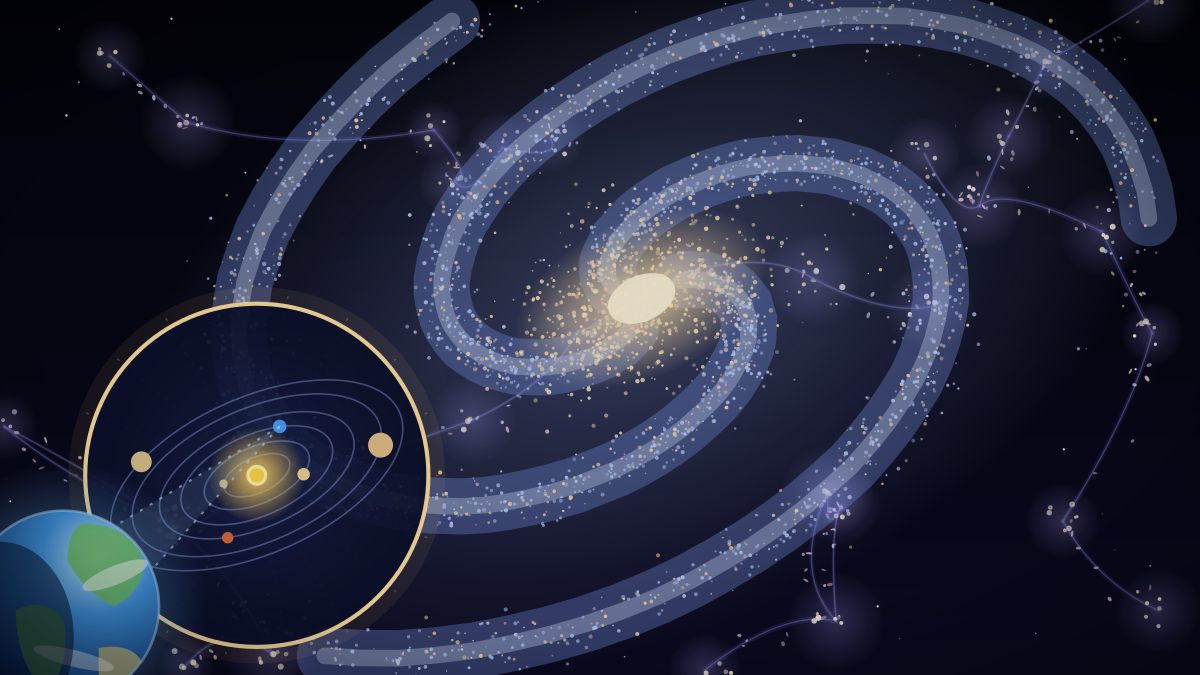
One light-year is about 6 trillion miles, and light travels at 186,000 miles per second. The nearest star to the Sun is about four light-years away. The Milky Way is about 100,000 light-years across.[2] The Milky Way's disk of stars spans more than 100,000 light-years, and its neighborhood, the Local Group, contains over 50 other galaxies.[5] The Sun takes about 240 million years to orbit the Milky Way once.[5]
How many galaxies
Galaxies range from a few hundred light-years across to more than a million, and from a few thousand stars to trillions of stars.[5] Groups hold about 100 or fewer galaxies, and clusters may contain thousands.[5] For the observable universe, estimates differ. A NASA article states that deep field images suggest hundreds of billions, perhaps a trillion, galaxies.[2] A 2016 study based on Hubble images, led by Christopher Conselice of the University of Nottingham, concluded that there are at least 10 times more galaxies than the earlier estimate of about 200 billion, implying roughly 2 trillion or more. That result relies on models that infer galaxies too faint and distant for present telescopes, which is the case for about 90 percent of them.[4]
Age and structure of galaxies
The universe formed about 13.8 billion years ago, and most galaxies are 10 to 13.6 billion years old, while the youngest known galaxy formed about 500 million years ago.[5] Larger galaxies typically hold supermassive black holes at their centers, some billions of times the Sun's mass.[5] The largest galaxies can exceed a million light-years across and hold trillions of stars, while dwarf galaxies in the Local Group have up to a few billion.[5]
Why the sky is still dark
With so many galaxies, every patch of sky should contain part of one. The night sky still looks dark because the redshift from expansion, the changing nature of the universe, and absorption by dust and gas reduce the visible and ultraviolet light the galaxies emit.[4]
Key figures
- Age of the universe: about 13.8 billion years.[1]
- Observable universe, diameter: about 92 to 93 billion light-years.[2][3]
- Galaxies: hundreds of billions to about 2 trillion, depending on method.[2][4]
- Total size: unknown.[2]
Sources6tap to view
- NASA Science. Universe Overview. 2026-10-07. Accessed October 7, 2026.
- NASA. How Big is Space? We Asked a NASA Expert: Episode 61. 2026-10-07. Accessed October 7, 2026.
- Encyclopaedia Britannica. Observable universe. 2026-10-07. Accessed October 7, 2026.
- NASA Science. Hubble Reveals Observable Universe Contains 10 Times More Galaxies Than Previously Thought. 2016-10-13. Accessed October 7, 2026.
- NASA Science. Galaxy Basics. 2026-10-07. Accessed October 7, 2026.
- Wikipedia. Observable universe. 2026-10-08. Accessed October 8, 2026.
Sources disagree slightly on the observable universe: about 92 billion light-years (NASA article) versus about 93 billion (Britannica). Galaxy counts range from hundreds of billions or perhaps a trillion (NASA article) to roughly 2 trillion or more (2016 Hubble-based study, which is model dependent; the 2 trillion figure is an implication of the 10-times statement, not a number printed in the release). The Britannica figure of 46 billion light-years for the radius is the source's own rounded value. Undated pages carry the retrieval date.