What Is Dark Matter?
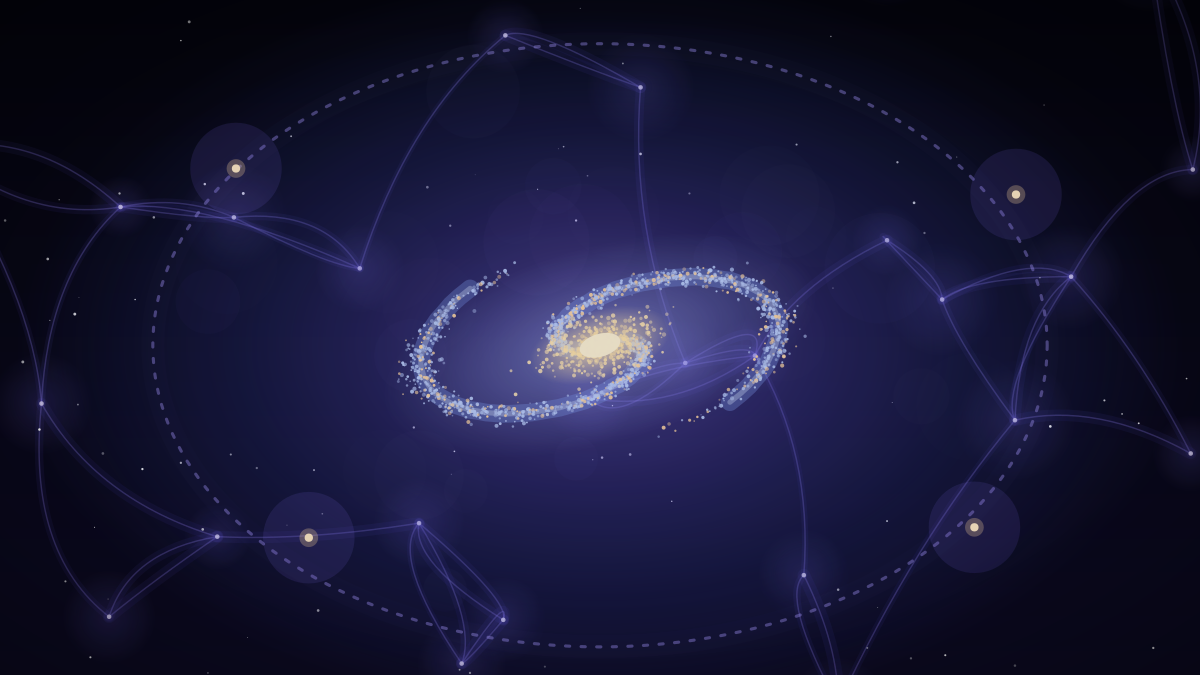
- Dark matter does not absorb, reflect or emit light, and is detected only through gravity.
- It is about 27 percent of the universe's contents, against about 5 percent for ordinary matter.
- Candidates such as WIMPs and axions have not been confirmed.
Invisible matter that has mass
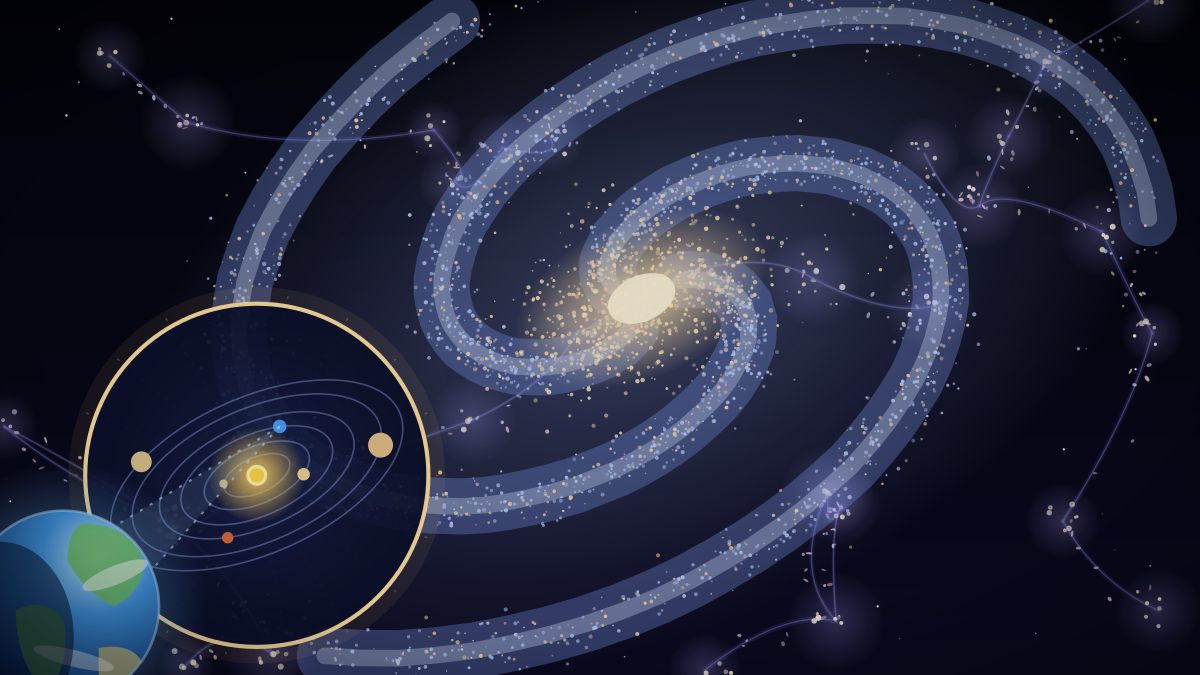
NASA describes dark matter as the invisible glue that holds the universe together and makes up most of the mass in galaxies and galaxy clusters. It does not absorb, reflect or emit light, but it takes up space and has mass, and it interacts with ordinary matter through gravity. The name refers to its invisibility, not to a dark color. Scientists have studied it for nearly 100 years and still do not know what it is.[1]
How much there is
According to NASA, ordinary matter makes up about 5 percent of the universe and dark matter about 27 percent, with dark energy accounting for the remainder.[1] ESA gives dark energy as 68 percent of the matter-energy density, based on estimates from its Planck mission, and says dark matter and dark energy together make up about 95 percent of the universe's mass and energy.[2] The US Department of Energy states that dark matter is about 85 percent of the total matter in the universe.[3] These numbers are consistent: dark matter at 27 percent and ordinary matter at 5 percent give a matter total of 32 percent, of which dark matter is roughly 85 percent.
Evidence from gravity
In 1933 Fritz Zwicky studied the Coma Cluster and found that its galaxies moved too fast to be held by the gravity of the visible matter. He proposed an invisible form of matter, which he called dunkle Materie.[1][3] In the 1970s Vera Rubin found that stars at the outer edges of spiral galaxies also moved too fast to be held by visible matter alone.[1] ESA notes that the missing mass in a typical galaxy is about ten times the mass of its visible stars.[2] Overall, the Department of Energy puts the measured gravity at about five times what all ordinary matter can explain.[3]
Gravitational lensing provides further evidence. The gravity of unseen matter bends light from more distant objects, and measuring the distortion maps where mass is located.[1][2] The Bullet Cluster, about 3.8 billion light-years away, is one of the clearest examples, according to NASA: hot gas, which is ordinary matter seen by the Chandra X-ray Observatory, is separated from the bulk of the mass found through lensing.[1] Hard-to-see ordinary matter such as cold hydrogen does not account for the missing gravity,[2] and the Department of Energy states that modified gravity theories do not match observations.[3]
A second NASA example is Abell 209, a galaxy cluster 2.8 billion light-years away in the constellation Cetus, which shows subtle lensing.[1] The Department of Energy adds that dark matter halos interacting during galaxy cluster collisions provide later evidence.[3]
Cold dark matter
Simulations favor cold dark matter, meaning slow-moving particles. Warm or hot dark matter does not reproduce the cosmic structures that are observed.[1]
Leading candidates
- WIMPs (weakly interacting massive particles): hypothetical heavy, slow-moving particles, with a mass of 1 to 1,000 times the proton mass. If they annihilate each other they may produce gamma rays, which NASA's Fermi telescope has searched for.[1][3]
- Axions: hypothetical low-mass particles proposed in 1977 to solve the strong CP problem, with roughly one ten-trillionth the mass of an electron.[1][3]
- Primordial black holes: hypothetical black holes formed shortly after the universe began, ranging from far below a paperclip's mass to about 100,000 solar masses. Recent studies suggest one could pass through the solar system about once every 10 years.[1]
None of these has been confirmed.[1]
How the search works
The Department of Energy lists three approaches. Direct detection uses large, sensitive detectors deep underground to look for dark matter particles passing through Earth. Indirect detection uses ground- and space-based observatories to look for signatures in cosmic rays and gamma rays. Particle accelerators such as the Large Hadron Collider are used to try to create dark matter.[3] Searches for compact ordinary objects have found nothing that could account for it.[3]
Dark matter and dark energy
The two are different. Dark matter holds galaxies together and is concentrated in them, while dark energy is thought to drive the accelerating expansion of the universe and is spread throughout space.[1] Evidence for accelerating expansion came from measurements in the 1990s.[2] ESA's Euclid mission aims to map galaxies over the last 10 billion years across more than a third of the sky, and NASA's Nancy Grace Roman Space Telescope is expected to help map the distribution of dark matter.[1][2]
Sources3tap to view
- NASA Science. Dark Matter. 2026-10-07. Accessed October 7, 2026.
- European Space Agency. The dark Universe (Euclid). 2026-10-07. Accessed October 7, 2026.
- US Department of Energy. DOE Explains...Dark Matter. 2026-10-07. Accessed October 7, 2026.
NASA gives dark matter as about 27 percent of the universe, ESA gives dark energy as 68 percent and a combined dark share of about 95 percent, and the Department of Energy gives about 85 percent of all matter; these are different ways of expressing the same cosmological model and are consistent. ESA's 68 percent comes from Planck-era estimates and later analyses may differ slightly. The statement that a 27 to 5 split gives about 85 percent of matter is simple arithmetic by the writer. Undated pages carry the retrieval date.