Galactic Crash Now a Coin Flip: Andromeda Collision Forecast Revised
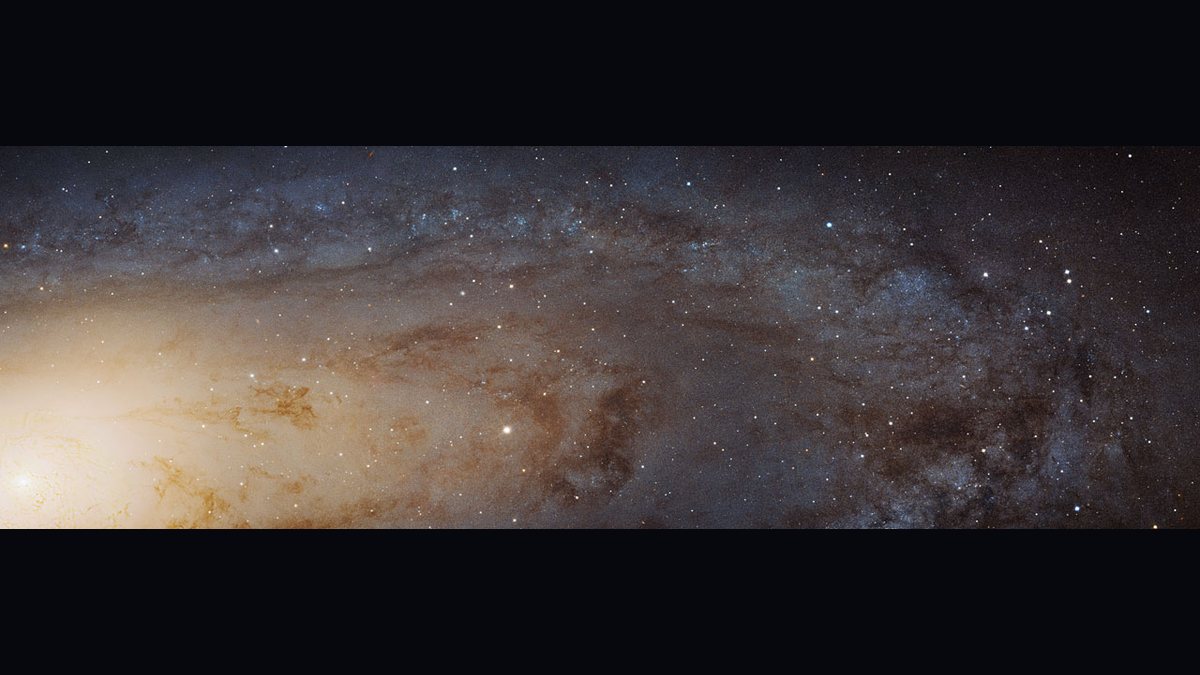
- A 2012 Hubble result pointed to a head-on collision in about 4 billion years.
- A 2025 study gives only about a 50-50 chance of a merger within 10 billion years.
- Even if galaxies merge, the Sun and Earth would not be destroyed by the collision itself.
The old forecast
In 2012, Hubble results indicated that Andromeda lay about 2.5 million light-years away and was approaching at roughly 400,000 kilometers per hour. Researchers reported the findings were statistically consistent with a head-on collision.[1] The predicted timeline was a first collision in about 4 billion years and a complete merger about 2 billion years after that.[1] The expected result was a single elliptical galaxy, with stars flung into scrambled orbits. The solar system would probably be tossed much farther from the galactic center, but was not expected to be destroyed.[1]
Later coverage of the newer work describes the previous consensus as a collision in about 4.5 billion years, treated as almost certain because Andromeda's sideways motion looked negligible.[2][3] The two summaries give slightly different numbers for the older forecast.
The 2025 update
A newer study combined more than a decade of Hubble observations with data from the European Space Agency's Gaia observatory.[2] The ESA Hubble summary says the team ran 100,000 Monte Carlo simulations covering 22 variables that could affect the outcome.[3] The result was a roughly 50-50 chance of collision within the next 10 billion years.[2][3] Within the nearer 4 to 5 billion year window, the chance of a head-on collision was only about 2 percent.[3]
One new factor is the Large Magellanic Cloud, whose gravity can alter the Milky Way's path and potentially lower the chance of a collision.[2] The Durham University announcement adds that if a merger does happen, 7 to 8 billion years from now is the most likely timeframe, much later than older predictions.[4] In most other scenarios the two galaxies instead pass at vast distances with little interaction.[4] The ESA Hubble summary says that in about half the simulations the galaxies pass within roughly 500,000 light-years, about five times the Milky Way's diameter.[3]
What it would mean
- If the galaxies merge, the Durham release says the result would be an elliptical galaxy, possibly with radiation as gas funnels into a central black hole.[4]
- The ESA Hubble summary points out that Earth is expected to become uninhabitable in about 1 billion years and the Sun to burn out in about 5 billion, making the collision a minor worry by comparison.[3]
- The Durham announcement says the new work does not show errors in earlier calculations; rather, newer data and a much wider range of scenarios revealed possibilities that were not previously explored.[4]
The takeaway is less a prediction than a reminder: the long-term fate of galaxies depends on small measurements, and better data can change the forecast.
The underlying paper
The study appeared in Nature Astronomy on June 2, 2025, with Till Sawala, Jehanne Delhomelle, Alis J. Deason, Carlos S. Frenk and colleagues as authors. Its abstract concludes that uncertainties in the present positions, motions and masses of all the galaxies leave room for drastically different outcomes, with a probability close to 50 percent that no merger occurs within 10 billion years.[5] The paper finds that M33, a satellite of Andromeda, raises the likelihood of a merger, while the Large Magellanic Cloud, on a perpendicular orbit, lowers it.[5][6] NASA's summary adds that the chance of a head-on collision within 4 to 5 billion years is only about 2 percent.[6]
Sources6tap to view
- Astronomy.com. Hubble shows Milky Way is destined for head-on collision with Andromeda Galaxy. Accessed October 5, 2026.
- Space Telescope Science Institute. Apocalypse When? Hubble Casts Doubt on Certainty of Galactic Collision. June 2, 2025. Accessed October 5, 2026.
- ESA/Hubble. heic2508 Science Release. June 2, 2025. Accessed October 5, 2026.
- Durham University. New study casts doubt on the likelihood of Milky Way collision with Andromeda. 2 June 2025. Accessed October 5, 2026.
- Nature Astronomy (Sawala et al.). No certainty of a Milky Way-Andromeda collision. June 2, 2025. Accessed October 5, 2026.
- NASA Science. Apocalypse When? Hubble Casts Doubt on Certainty of Galactic Collision. June 2, 2025; updated May 27, 2026. Accessed October 5, 2026.
The older forecast is given as about 4 billion years (Astronomy.com, 2012 coverage) and about 4.5 billion years (2025 coverage). The 2025 study's headline odds also appear in two forms: about 50-50 over 10 billion years, and about 2 percent for a head-on collision within 4-5 billion years. The final sentence is general commentary.