Voyager 1 Nears One Light-Day From Earth, a First for Any Human-Made Object
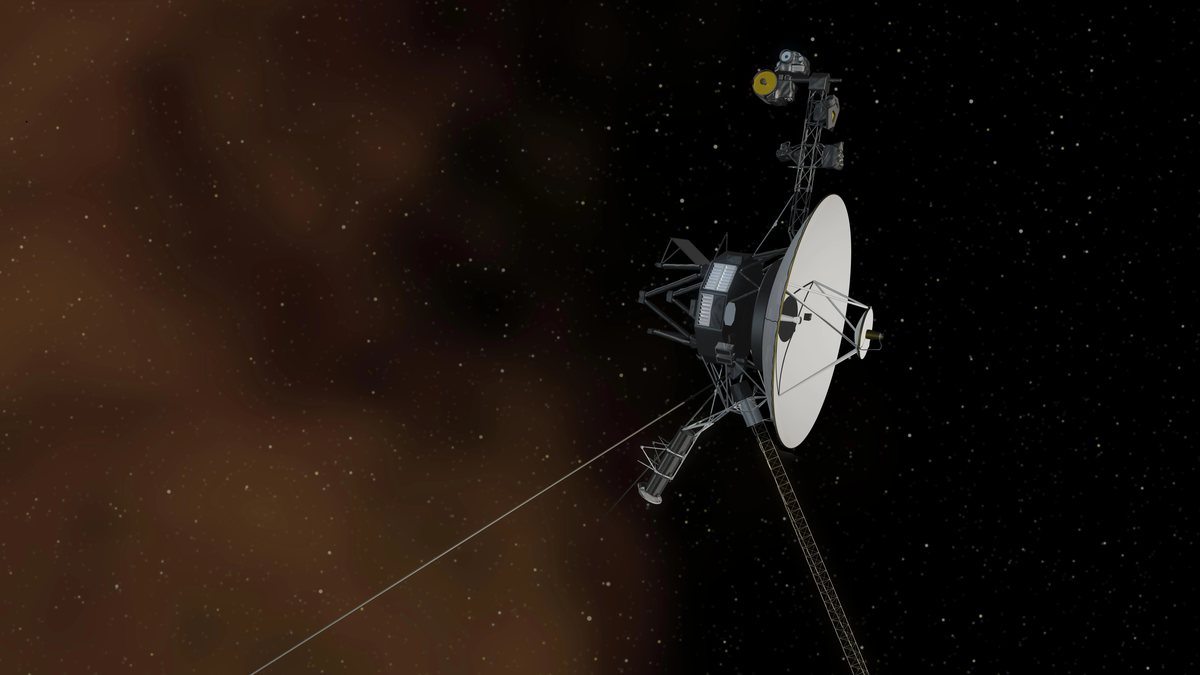
- Voyager 1 launched on September 5, 1977 and entered interstellar space in August 2012.
- It will reach one light-day from Earth in mid-November 2026, though sources give three different dates.
- Instruments are being switched off to save power, with signals expected to end in the 2030s.
From launch to interstellar space
Voyager 1 launched on September 5, 1977.[1] On August 25, 2012, it became the first spacecraft to exit the heliosphere, the Sun's protective bubble of particles and magnetic fields, and enter interstellar space.[1][2] Sky at Night magazine notes that it has been the farthest-traveling human-made object since February 1998, when it overtook Pioneer 10.[3] NASA's Voyager 1 profile still carries an older figure of 164.7 astronomical units from Earth as of August 21, 2024, moving at about 17 kilometers per second relative to the Sun.[1] That figure has been overtaken: NASA's status page, updated August 20, 2026, gives the distance on November 18, 2026, as 16.094 billion miles (25.902 billion kilometers), which is one light-day, or about 173 astronomical units by conversion, so a radio signal will then need 24 hours to travel one way.[2]
The one light-day milestone
A light-day is the distance light travels in 24 hours. NASA says Voyager 1 will become the first human-made object to reach that distance from Earth, about 16.094 billion miles.[2] The date, however, depends on the source. NASA's tracking page gives November 18, 2026.[2] Sky at Night gives about November 13, with a distance of roughly 25.9 billion kilometers.[3] Popular Science gives November 15.[4] The differences amount to a few days, and the sources do not explain the gap.
For scale, Sky at Night calculates that after 48 years of travel Voyager 1 has covered only about 0.0027 percent of the distance to Proxima Centauri, and that it will not reach the Oort Cloud for around 300 years.[3]
A fading power supply
The spacecraft runs on the heat from decaying plutonium-238, and Sky at Night reports its power output is now about half the launch level.[3] Popular Science says its three radioisotope generators are expected to run out sometime in the 2030s even without further technical trouble.[4] NASA notes that multiple instruments on both Voyagers have been turned off over the years to conserve power. As of April 17, 2026, NASA's instrument table shows two instruments operating on Voyager 1 (the magnetometer and the plasma wave subsystem) and three on Voyager 2 (the cosmic ray subsystem, the magnetometer and the plasma wave subsystem).[2]
- Data comes back at about 160 bits per second, Sky at Night says, and the magazine states that NASA estimates signal detection will end by 2036.[3]
- The probe's cameras were shut down in 1990.[3]
- Voyager 1 is headed toward the constellation Ophiuchus.[3]
Even after contact ends, Sky at Night notes, the probe will not truly exit the Solar System for roughly 30,000 years.[3]
The sister probe and the power budget
NASA describes the two Voyagers as the only spacecraft ever to operate outside the heliosphere, and reports that engineers at the Jet Propulsion Laboratory have freed up power on Voyager 2 to extend its operating life.[5] Voyager 2 launched on August 20, 1977, and entered interstellar space on November 25, 2018, becoming the second human-made object to do so.[6] Both probes are powered by three plutonium-238 radioisotope generators, which NASA says were in stable operation at 225 watts electrical as of 2023, with loads switched off as output declines; telemetry normally returns at 160 bits per second.[7]
Sources7tap to view
- NASA Science. Voyager 1. September 28, 2026. Accessed October 5, 2026.
- NASA Science. Where Are Voyager 1 and 2 Now?. 2026-08-20. Accessed October 5, 2026.
- BBC Sky at Night Magazine. NASA Voyager 1 light-day. May 25, 2026. Accessed October 5, 2026.
- Popular Science. Voyager 1 is almost one light-day from Earth. Accessed October 5, 2026.
- NASA Science. Voyager. Updated August 5, 2026. Accessed October 5, 2026.
- NASA Science. Voyager 2. Updated September 28, 2026. Accessed October 5, 2026.
- NASA Science. Voyager Spacecraft. Updated April 17, 2026. Accessed October 5, 2026.
Sources disagree on the one light-day date: NASA says November 18, 2026; Popular Science says November 15; Sky at Night says about November 13. The NASA distance figure of 164.7 AU is from August 2024 and is dated. Radio-signal travel time is given as about 22.8 hours (NASA, 2024) and a little over 23 hours (Popular Science). Distance, light-time and instrument counts were rechecked against NASA pages on October 5, 2026.