What the James Webb Space Telescope Sees: The Universe in Infrared
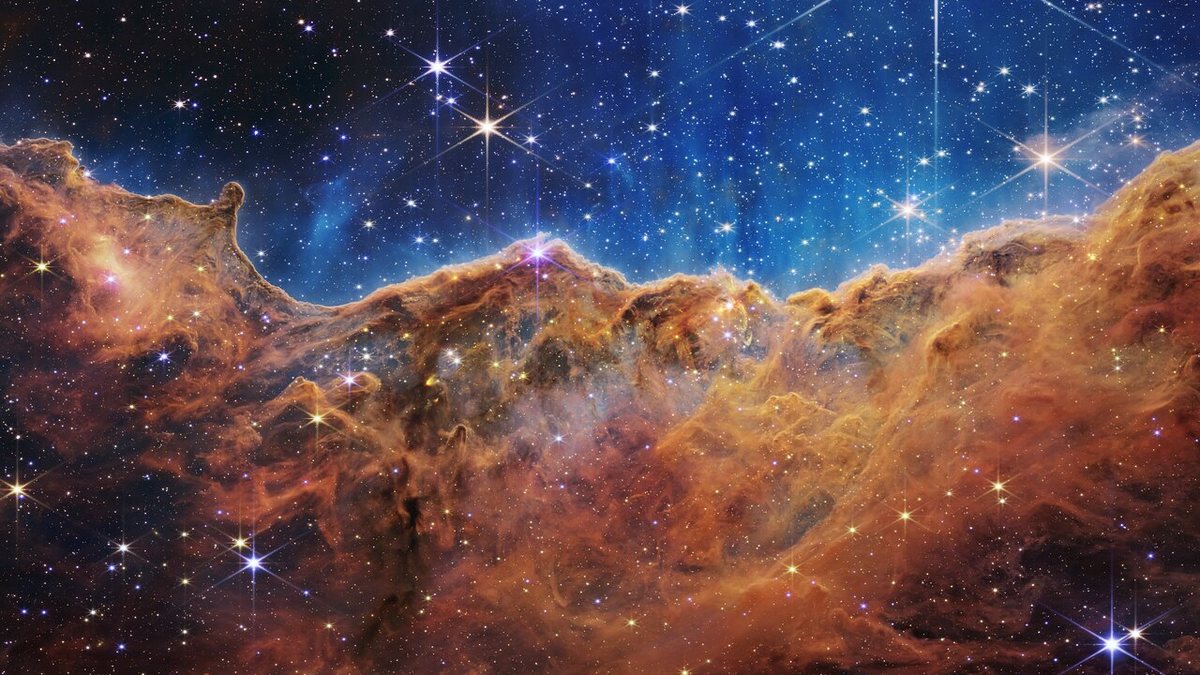
- Webb observes visible-to-mid-infrared light, roughly 0.6 to 28 micrometers.
- Its 6.5-meter mirror collects almost six times more light than Hubble's.
- It targets early galaxies, star formation, galaxy evolution and exoplanets.
A telescope built for infrared
Webb launched on December 25, 2021, from Europe's spaceport in French Guiana on an Ariane 5 rocket, as a partnership of NASA, ESA and the Canadian Space Agency.[1][2] It does not orbit Earth like Hubble. It circles the Sun about 1.5 million kilometers (1 million miles) from Earth at the second Lagrange point, L2.[1]
The reason for the odd location is the heat. Infrared instruments must work at temperatures just a few tens of degrees above absolute zero, or the telescope's own warmth would swamp the signal.[5] Webb carries a five-layer sunshield that NASA likens to SPF 1 million sunscreen, blocking infrared from the Sun, Earth and Moon.[1]
Mirror and instruments
The primary mirror is 6.5 meters across and collects almost six times more light than Hubble.[2] It is built from 18 hexagonal segments, each 1.32 meters wide, coated with a microscopically thin layer of gold that is well suited to reflecting infrared light.[4] A convex secondary mirror about 0.74 meters across completes the optics.[4] The segments fold up to fit inside the rocket.[5]
Four science instruments share the work: MIRI, NIRSpec, NIRCam and FGS-NIRISS, covering near- and mid-infrared imaging and spectroscopy.[2] ESA gives Webb's range as about 0.6 to 28 micrometers, from visible light to mid-infrared, compared with Hubble's 0.1 to 2.5.[2] Hubble itself orbits only 560 kilometers above Earth.[1] NASA's older page says Webb's mirror is more than 2.5 times larger than Hubble's.[5] An older NASA page lists the upper limit as 28.5 micrometers.[5]
What it is looking for
NASA groups Webb's science into four themes: the early universe, galaxies over time, the lifecycles of stars, and other worlds.[1] Infrared sight reveals stars wrapped in dust clouds, water in the atmospheres of other planets, and the first light from some of the earliest galaxies.[3] The telescope probes "Cosmic Dawn," roughly 50 million to one billion years after the Big Bang, and NASA says Webb can look back more than 13.5 billion years to the first galaxies.[3][1]
For exoplanets, Webb can reveal what atmospheres are made of and offer clues about climate and weather, which feeds the broader search for life elsewhere.[3] Its infrared range, which starts at visible red light and runs deep into the infrared, is also what lets it study the heat signatures of objects across the universe.[5] It also studies objects within the Solar System.[3]
NASA sums up the mission as studying every phase in the history of the Universe, from the first light after the Big Bang to the evolution of planetary systems.[1]
Sources5tap to view
- NASA Science. James Webb Space Telescope: Facts. 2026-10-01. Accessed October 5, 2026.
- European Space Agency. Webb factsheet. Accessed October 5, 2026.
- NASA Science. Webb Science Overview. 2026-07-16. Accessed October 5, 2026.
- ESA/Webb. Webb's mirrors. Accessed October 5, 2026.
- NASA Imagine the Universe. James Webb Space Telescope. 2018-12-11. Accessed October 5, 2026.
The upper end of Webb's wavelength range is given as about 28 micrometers by ESA and 28.5 by an older (2018) NASA page. The NASA Imagine page also says the mirror 'can be' 6.5 meters and weighs about half as much as Hubble's; only the 6.5 m figure is used here.