The Life Cycle of the Sun: From Gas Cloud to White Dwarf
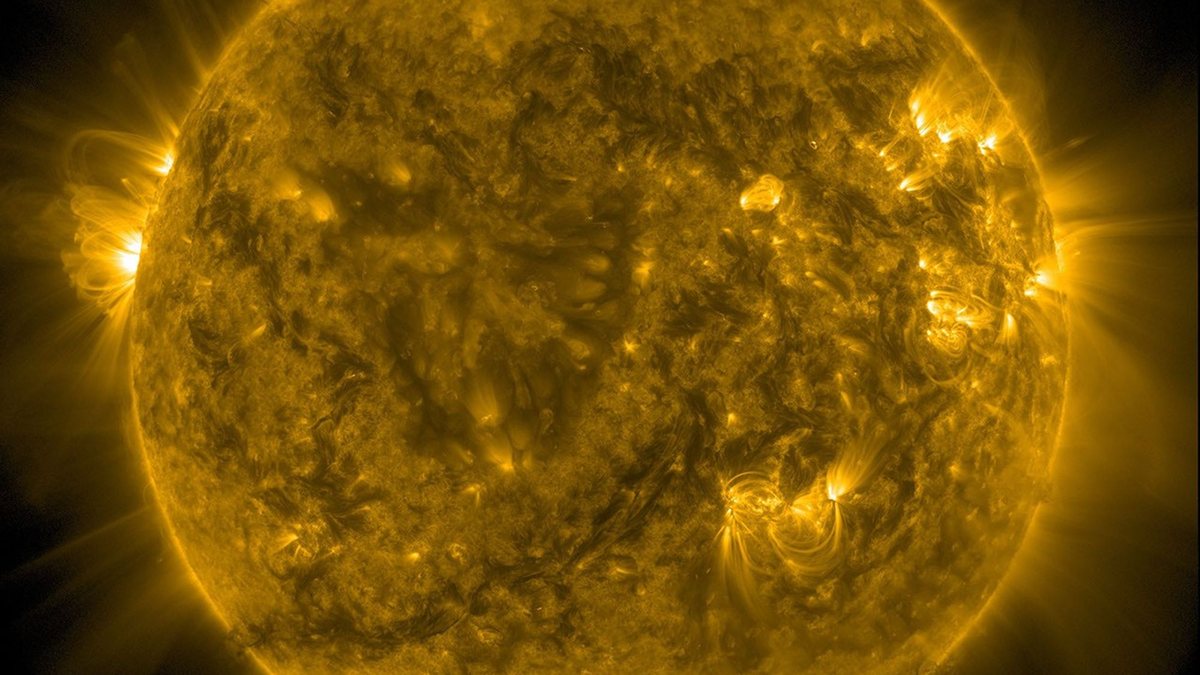
- The Sun formed about 4.5 to 4.6 billion years ago from a collapsing cloud of gas and dust.
- It will keep fusing hydrogen for about another 5 billion years.
- It will swell into a red giant, shed its outer layers, and leave a white dwarf.
Born from a cloud
The Sun formed about 4.6 billion years ago from the collapse of a large cloud of interstellar gas and dust, according to StarDate, and today it steadily fuses hydrogen into helium in its core.[3] Universe Today says the protostar stage lasted roughly 100,000 years before fusion ignited.[4] NASA describes the result as a yellow dwarf star, a ball of hydrogen and helium held together by its own gravity, about 100 times wider than Earth.[1] Its diameter is about 1.4 million kilometers (865,000 miles), it would take more than 330,000 Earths to match its mass, and it lies about 150 million kilometers from Earth.[1]
A long, steady middle age
Stars stay stable because of a balance: gravity tries to crush the star inward, while pressure from heat and nuclear reactions in the core pushes outward.[2] Sun-like stars spend billions of years in this phase, called the main sequence, while very massive stars burn through theirs in millions of years.[2] NASA puts the Sun a little less than halfway through its lifetime, with about 5 billion years to go.[1]
Red giant, nebula, white dwarf
When hydrogen fuel in the core runs low, the Sun will expand dramatically into a red giant. NASA says it could engulf Mercury and Venus and possibly Earth.[1] Universe Today describes an even more detailed sequence: a shrink to around 10 times the present size, then a second expansion to more than 1 astronomical unit in radius.[4] About a billion years after the red giant phase begins, StarDate says, the outer layers will be ejected as a planetary nebula, leaving an extremely hot but inert core: a white dwarf.[3] Universe Today estimates the nebula would disperse in about 10,000 years, and that the white dwarf would last for trillions of years before fading to black.[4]
Not every star follows this script. NASA's life-cycle resource says the final stage depends on initial mass, and can be a white dwarf, a neutron star or a black hole.[2] Universe Today adds that by the time the nebula forms, only about half of the Sun's present mass will remain, a process taking roughly 500,000 years.[4]
Why the numbers differ
Quoted figures vary from source to source. The Sun's age appears as 4.5 billion years on one NASA page, 4.6 billion at StarDate, and 4.57 billion at Universe Today.[1][3][4] The remaining main sequence time is "another 5 billion years" at NASA but 4.5 to 5.5 billion years at Universe Today, which places the red giant onset near 5.4 billion years from now.[1][4] None of these is a contradiction so much as a different rounding of estimates built from models.
Sources4tap to view
- NASA Science. Sun Facts. 2026-09-17. Accessed October 5, 2026.
- NASA Science. Star life cycles (NASA Science resource). 2025-05-20. Accessed October 5, 2026.
- StarDate (McDonald Observatory, UT Austin). Lifetime of a Star. 2023-07-17. Accessed October 5, 2026.
- Universe Today. What is the Life Cycle of the Sun?. 2025-06-13. Accessed October 5, 2026.
Sources disagree on small points: the Sun's age (4.5 billion years per NASA, 4.6 per StarDate, 4.57 per Universe Today), the remaining hydrogen-burning time (about 5 billion years per NASA, 4.5-5.5 billion per Universe Today), and Universe Today itself gives conflicting red giant durations (120 million years total vs 100 million for helium burning alone). The Universe Today date is its last-modified date; it was first published 2015-12-22.