Einstein Probe Catches Faint X-ray Flash From the First Moments of Supernova SN 2026gzf
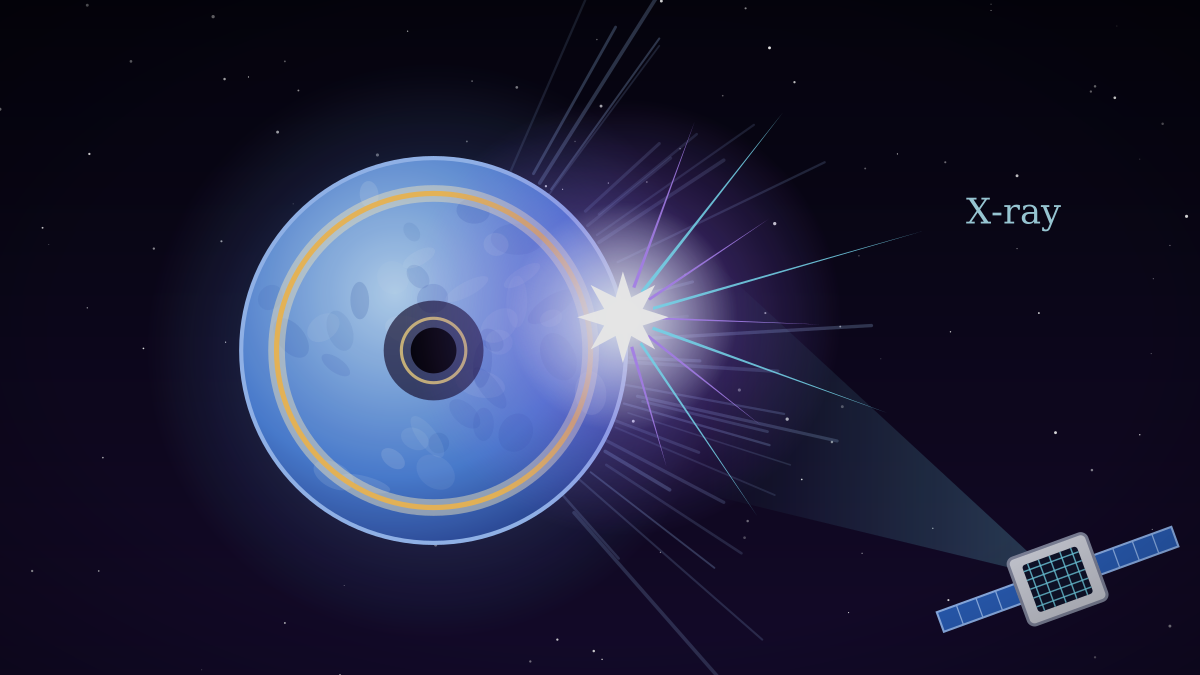
- Einstein Probe detected a soft X-ray flash on 21 March 2026 that preceded supernova SN 2026gzf.
- The event is described as only the second confirmed X-ray shock breakout in two decades.
- No gamma-ray burst or relativistic jet was found, though the supernova otherwise resembled energetic ones.
A supernova caught at the start
The Einstein Probe, an X-ray satellite operated by the Chinese Academy of Sciences, detected a soft X-ray flash on 21 March 2026, designated EP260321a.[1][2] The flash came from a galaxy about 500 million light-years away and was followed by a supernova named SN 2026gzf.[1][3] Results were reported on 5 August 2026 in The Astrophysical Journal Letters.[2]
What a shock breakout is
When the core of a massive star collapses, a shock wave travels outward through the star. A shock breakout is the moment that wave reaches the stellar surface and releases a brief burst of radiation, before the debris expands and the supernova brightens. University of Maryland researchers describe this as captured in unprecedented detail, and describe it as only the second confident shock breakout identification in two decades.[2] The McDonald Observatory release calls it the second confirmed X-ray shock breakout in the same period.[1]
An unusual type of explosion
SN 2026gzf was classified as a broad-lined Type Ic supernova (Ic-BL). The label Type Ic means the spectrum shows no hydrogen or helium, and broad lines indicate very fast-moving ejecta.[1][2] The progenitor is described as a Wolf-Rayet star of roughly 20 solar masses, a massive star that had shed its hydrogen and helium before exploding.[1][2]
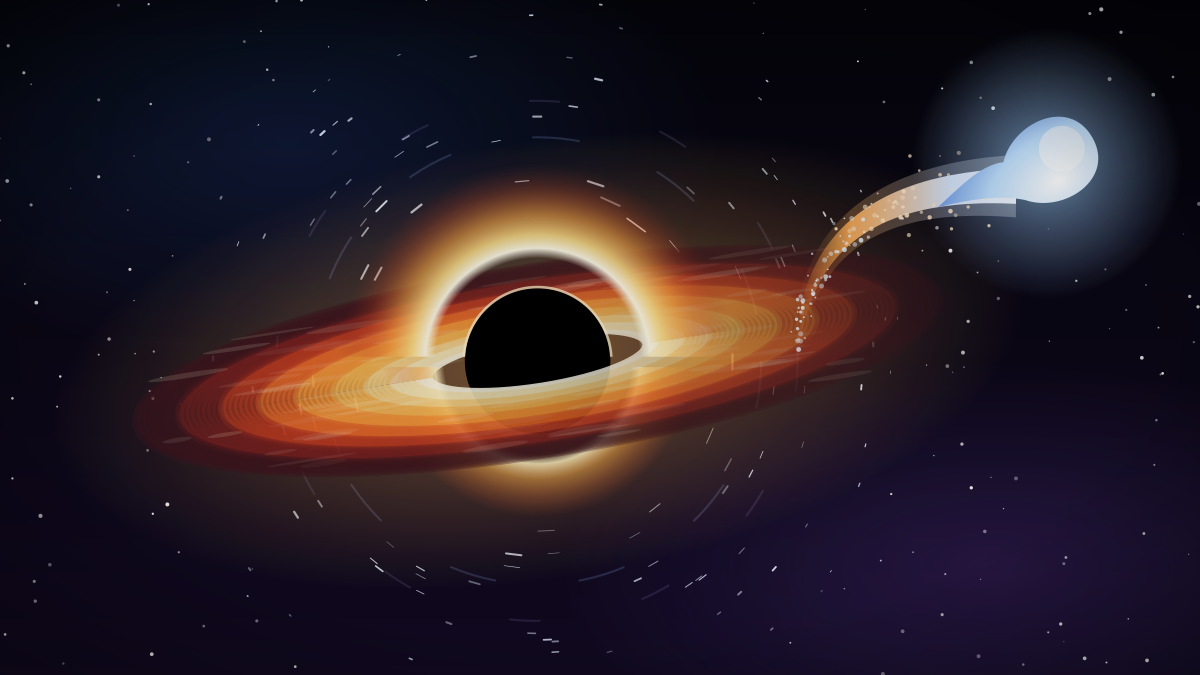
Ic-BL supernovae are often associated with gamma-ray bursts and relativistic jets, narrow streams of matter moving close to the speed of light. In this case no gamma-ray burst was detected, and the X-ray breakout was the faintest ever associated with an Ic-BL supernova, according to McDonald Observatory.[1] SALT, the Southern African Large Telescope, quotes the researcher O'Connor as noting that SN 2026gzf looks remarkably similar to other energetic supernovae but shows no evidence for a relativistic jet or an afterglow.[3]
Many telescopes, one event
After the X-ray alert, follow-up observations involved a large set of facilities. Reports name the Hobby-Eberly Telescope, Gemini North and South, the SOAR 4.1-meter telescope, the Vera C. Rubin Observatory, the Chandra X-ray Observatory, the Very Large Array radio telescope and Palomar Observatory.[1] SALT obtained eight spectra over about two months, and the Dark Energy Camera and the Dark Energy Spectroscopic Instrument also contributed.[3] Lists of instruments vary between press releases, since each emphasizes its own contribution.
The study involved separate teams and papers. Brendan O'Connor of Carnegie Mellon University and Jillian Rastinejad of the University of Maryland are named as lead researchers, and Greg Zeimann of McDonald Observatory is also listed.[1][2] The University of Maryland release credits Rastinejad as lead and lists Gokul Srinivasaragavan, Stephen Bradley Cenko and Robert Stein among the team.[2]
A further account lists the Dark Energy Camera, the Vera C. Rubin Observatory's LSST Camera, the Dark Energy Spectroscopic Instrument, Gemini and SOAR among the facilities used, and credits both O'Connor and Rastinejad as authors of the associated papers in The Astrophysical Journal Letters.[4] It repeats that the progenitor was a Wolf-Rayet star of about 20 solar masses and that no relativistic jets or gamma-ray burst were seen, despite the similarity to other Ic-BL events.[4] The agreement among these releases on the detection date, distance and classification supports the basic description, although all of them derive from the same research collaborations.
Interpretation and limits
The researchers conclude that massive stars can die through a wider range of pathways than previously recognized, and that the event may bridge ordinary supernovae and the most extreme cosmic explosions.[2][3] This is an interpretation of a single event. It is not yet known how common such jet-free, X-ray-faint breakouts are, and further detections would be needed to establish a population.
- Event names: EP260321a (X-ray flash) and SN 2026gzf (supernova).[3]
- Distance: about 500 million light-years.[2]
- Type: broad-lined Type Ic.[2]
- Progenitor: Wolf-Rayet star of about 20 solar masses.[2]
Sources4tap to view
- McDonald Observatory. Astronomers Catch Massive Star's Death from the First Explosive Moment. 2026-08-05. Accessed October 5, 2026.
- University of Maryland College of Computer, Mathematical, and Natural Sciences. Rare Supernova Observation Reveals New Ways That Stars Can Die. 2026-08-05. Accessed October 5, 2026.
- South African Astronomical Observatory. SALT Helps Trace a Massive Star's Death from Its First Explosive Moment. 2026-08-05. Accessed October 5, 2026.
- Newswise. Astronomers Catch Massive Star's Death from the First Explosive Moment. Accessed October 5, 2026.
The coverage comes from press releases of participating institutions; the journal papers were not opened. Lead authors and instrument lists differ between releases because separate teams and papers are involved.