Closer to the Sun, Yet Cooler: Why Venus Out-Burns Mercury
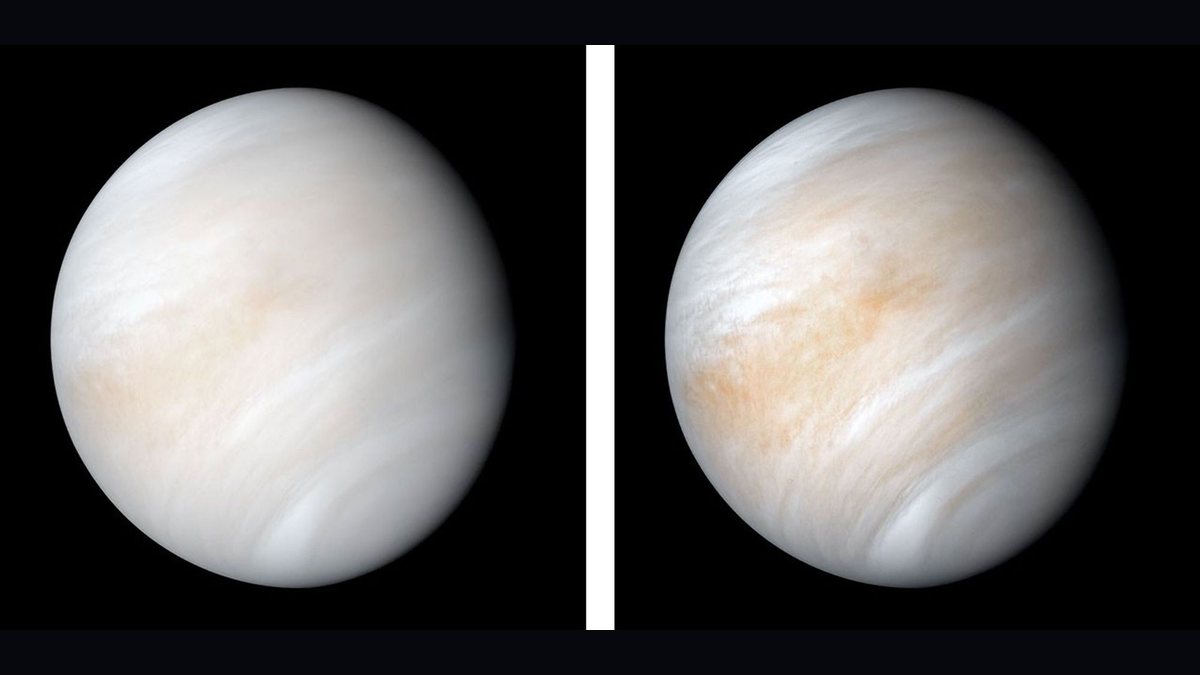
- Venus has a surface near 467 C day and night, while Mercury swings from about 430 C to minus 180 C.
- Venus is wrapped in a dense carbon dioxide atmosphere that traps heat; Mercury has almost none.
- A runaway greenhouse effect likely transformed Venus long ago, though sources differ on the timing.
A hotter world farther from the Sun
Mercury orbits at an average distance of about 58 million kilometers from the Sun, roughly 0.4 astronomical units. Venus circles at about 108 million kilometers, or 0.72 astronomical units.[1][2] Intuition says the closer planet should be the hotter one. It is not. NASA gives Venus a surface temperature of about 467 degrees Celsius (872 degrees Fahrenheit), hot enough to melt lead.[1] Mercury's sunlit side reaches about 430 C, but its night side plunges to about minus 180 C.[2]
The contrast is striking in another way as well. According to a university explainer, Venus holds its heat constantly, day and night, while Mercury's temperature swings across more than 600 degrees.[3]
The blanket effect
The difference comes down to atmosphere. Venus is wrapped in a thick envelope of carbon dioxide with dense clouds of sulfuric acid, and the pressure at the surface is about 93 times that at sea level on Earth.[1] Greenhouse gases such as carbon dioxide absorb infrared radiation, which slows heat loss to space and warms the planet.[4]
Mercury has nothing comparable. It has only a thin exosphere made of atoms knocked off the surface by the solar wind and by meteoroid impacts.[2] Sky at Night magazine describes this as too thin to retain heat.[4] Sunlight heats the ground, and with no blanket overhead, the warmth drains away after dark.
How Venus ended up this way
NASA describes the cause as a runaway greenhouse effect.[1] The USC Dornsife explainer lays out the sequence: as the young Sun brightened, water on Venus evaporated into the air. Without surface water to absorb and store carbon dioxide, that gas built up, and the warming fed on itself in a loop of ever more evaporation.[3] One line from that article sums up the idea: imagine all of Earth's oceans evaporating and their dissolved carbon dioxide being released.[3]
Sky at Night suggests that Venus may once have looked like Earth, possibly with liquid water, and that the runaway greenhouse effect ultimately sterilized it.[4] The magazine presents the planet as a cautionary example of what unchecked greenhouse gas buildup can do.[4]
- Venus takes about 225 Earth days to orbit the Sun, yet one Venus day lasts about 243 Earth days, and the planet spins backward compared with Earth.[1]
- Mercury turns on its axis every 59 Earth days, but one full day-night cycle there lasts about 176 Earth days.[2]
Venus therefore shows that a planet's temperature depends on what surrounds it as much as on how close it sits to a star.
The European Space Agency's BepiColombo factsheet makes the same point from Mercury's side: the planet has a lower average temperature than Venus because it has no atmosphere to help regulate temperature, yet it still holds ice in permanently shadowed craters. The factsheet says Mercury rotates three times for every two orbits, giving a day of 176 Earth days and a year of 88. The BepiColombo spacecraft, launched on October 20, 2018, is scheduled to enter Mercury orbit on November 21, 2026.[6] NASA's Venus overview calls the planet the hottest in the solar system, with a surface hot enough to melt lead, and notes that Mariner 2 in 1962 was the first spacecraft to visit any planet beyond Earth.[5]
Sources6tap to view
- NASA Science. Venus Facts. September 28, 2026. Accessed October 5, 2026.
- NASA Science. Mercury Facts. April 25, 2025. Accessed October 5, 2026.
- USC Dornsife. Why is Venus hotter than Mercury, when Mercury is closer to the Sun?. Accessed October 5, 2026.
- BBC Sky at Night Magazine. Venus is the hottest planet, even though Mercury is closer to the Sun. This is why. Accessed October 5, 2026.
- NASA Science. Venus. Updated September 21, 2026. Accessed October 5, 2026.
- European Space Agency. BepiColombo factsheet. Accessed October 5, 2026.
Sources differ slightly on Venus's surface temperature (NASA about 467 C; the USC explainer and Sky at Night about 464 C) and on surface pressure (about 93, more than 90, or nearly 100 times Earth's). They also differ on when Venus may have been Earth-like: the USC page says about 4.5 billion years ago, Sky at Night says about 4 billion years ago and hedges about water. The closing sentence and the remark that Mercury's warmth drains away after dark are general commentary.