Webb Spectra Reveal a Third Giant Planet, Beta Pictoris d, in a Well-Studied Young System
- Beta Pictoris d was found from a carbon monoxide signal in spectra of its neighbor, not from a direct image.
- It is at least about twice the mass of Jupiter and orbits near 30 astronomical units.
- A second team using ESO's Very Large Telescope reported the planet independently.
A planet found in the noise
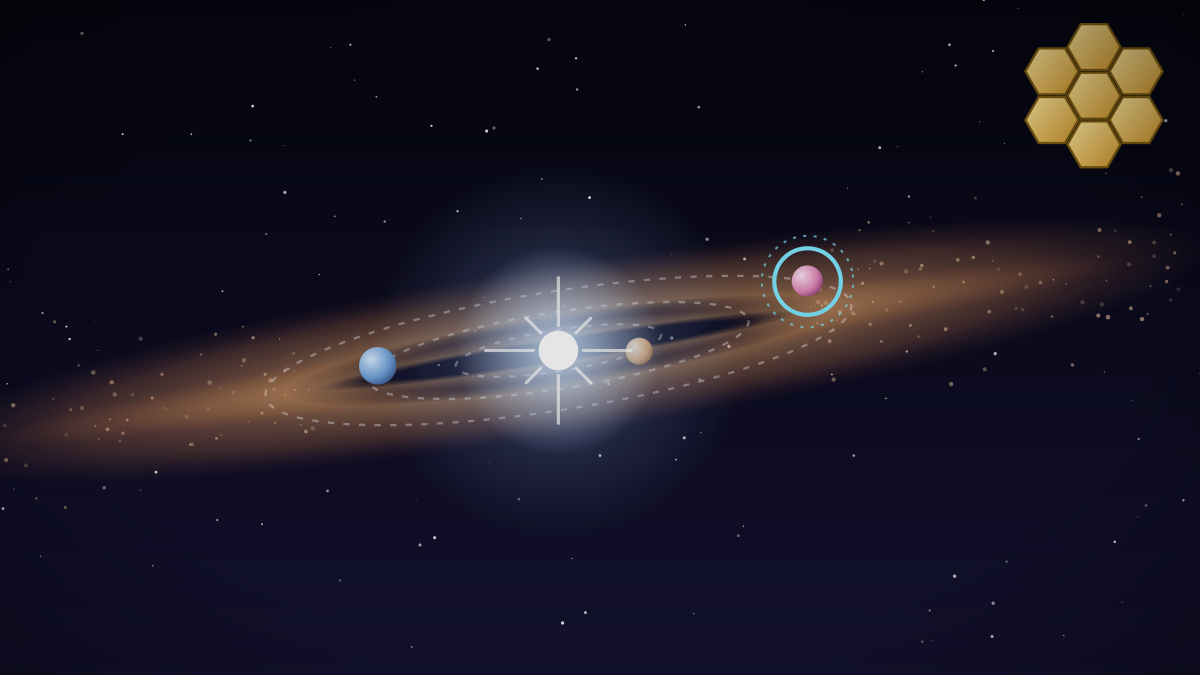
Astronomers using NASA's James Webb Space Telescope have identified a third giant planet around Beta Pictoris, a young star about 63 light-years from Earth.[1] The new world, named Beta Pictoris d, joins Beta Pictoris b and Beta Pictoris c, which were already known.[1] According to the Space Telescope Science Institute, the system is only the second known to contain at least three planets that have been imaged.[1]
The star is about 23 million years old and is surrounded by a debris disk, a belt of dust and rock fragments left over from planet formation, which was first discovered in 1983.[1][2]
How the detection worked
Unlike its two siblings, the new planet was not first seen as a point of light. Researchers led by Aidan Gibbs, a postdoctoral researcher at the University of California San Diego, were studying the atmosphere of Beta Pictoris b with the integral field unit of Webb's NIRSpec instrument, which records a spectrum (light split by wavelength) for every pixel of an image.[2][3] A pattern of carbon monoxide absorption appeared in the data where no known planet was expected.[2] Gibbs is quoted as saying the team had not been looking for a new planet but had been trying to understand one already known to exist.[3]
Follow-up observations reportedly detected water vapor and methane in the planet's atmosphere.[2][3] Webb's Mid-Infrared Instrument is credited with the water and methane detections and its Near-Infrared Camera with independent imaging confirmation, according to one report.[3] The agency presents this as a new approach for revealing planets hidden in dusty environments, where conventional coronagraphic imaging, which blocks starlight to expose faint companions, can fail.[1]
Properties of Beta Pictoris d
Reports describe the planet as the smallest of the three giants, with a mass of at least twice that of Jupiter, and an orbit of about 30 astronomical units from the star, a distance comparable to Neptune's from the Sun.[2][3] It lies just inside the inner edge of the debris disk.[2] One account gives a mass of roughly 2 to 4 Jupiter masses, an orbital period of about 91 years and an atmospheric temperature near 330 degrees Celsius.[4] Those figures differ in form from the lower limit quoted elsewhere, and the underlying paper was not consulted directly, so they are best treated as approximate.
A second, independent team
HotHardware reports that a team led by Markus Bonse, working with ESO's Very Large Telescope and its ERIS instrument, also spotted the planet and checked the result against more than 11 years of archival data.[4] The same article describes the planet as about 100 times fainter than Beta Pictoris b and as the faintest exoplanet ever directly imaged from the ground, and says its gravity helps shape the inner boundary of the debris disk.[4] These statements come from a single secondary source.
The Webb result is reported to be published, open access, in The Astrophysical Journal Letters.[2] The NASA and STScI release itself does not include a paper citation in the text consulted.[1]
Why the result matters
Direct imaging favors planets that are young, massive and far from their stars, and dust can hide fainter candidates. Identifying a planet through its chemical fingerprint in a spectrum offers another route to such objects.[1] Beta Pictoris has been a benchmark system for studying how planets form and interact with disks, having been observed extensively with the Hubble and Webb space telescopes.[1]
- Distance: about 63 light-years.[1]
- System age: about 23 million years.[2]
- Orbital distance of planet d: about 30 astronomical units.[3]
- Gases reported: carbon monoxide, water vapor, methane.[2]
Sources4tap to view
- Space Telescope Science Institute. NASA's Webb Discovers Hidden Planet in Famous Star System. 2026-07-15. Accessed October 5, 2026.
- Astrobiology.com. Webb Discovers A Hidden Planet In The Beta Pictoris Star System. 2026-07-16. Accessed October 5, 2026.
- Newswise. NASA's Webb Discovers Hidden Planet in Famous Star System. 2026-07-15. Accessed October 5, 2026.
- HotHardware. NASA's Webb Captures A Hidden Planet That Fooled Astronomers For Years. 2026-07-16. Accessed October 5, 2026.
Mass is given as at least 2 Jupiter masses in some reports and 2 to 4 in another; the period, temperature and the ESO team's independent detection come from one secondary source. The journal paper was not opened.