Near-Earth Object 1998 SH2, Tracked as an Asteroid Since 1998, Is Reclassified as a Comet
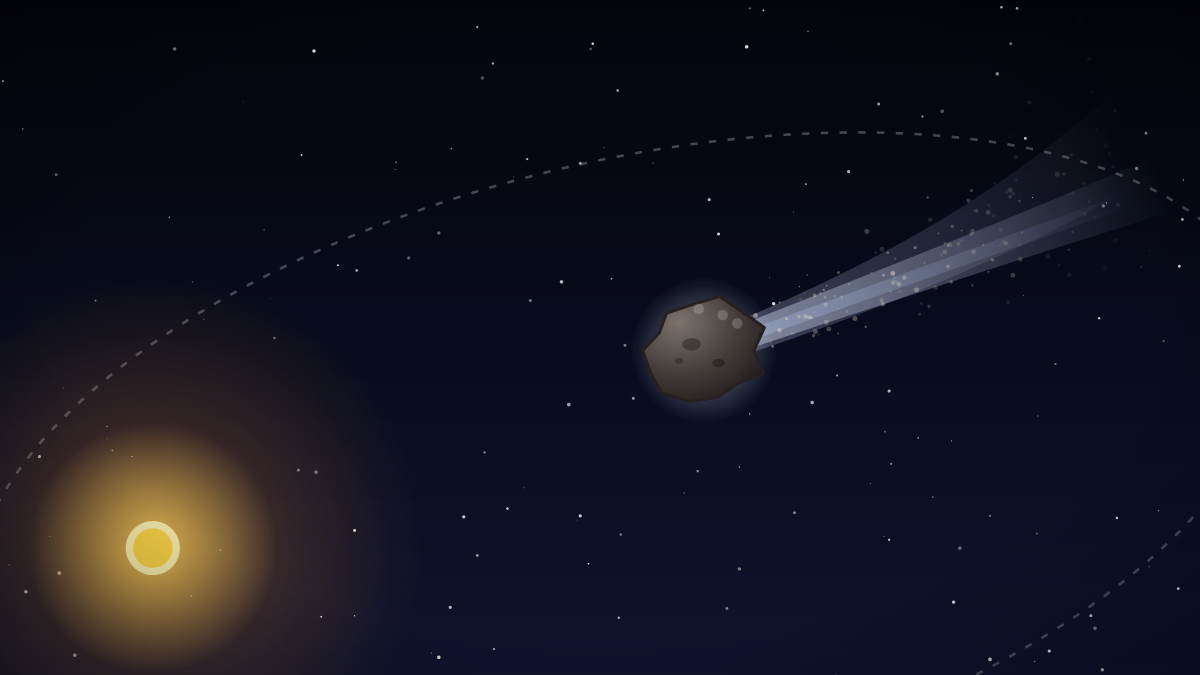
- Small unexplained orbital shifts of 1998 SH2 pointed to outgassing before any tail was seen.
- Three telescopes then detected a weak but clear tail, confirming a comet.
- The case is used as an example of how precise tracking can expose so-called dark comets.
An asteroid that behaved like a comet
The near-Earth object 1998 SH2, catalogued as an asteroid after its discovery in 1998, has been reclassified as a comet and now carries the designation P/1998 SH2.[1] The result comes from a study led by NASA's Jet Propulsion Laboratory (JPL) and published in Nature Astronomy on 16 July 2026.[2] The object follows an orbit of about 4.5 years around the Sun, and it passed within roughly 2 million miles of Earth on 28 August 2025.[2]
The finding is notable because the object was identified as a comet through its motion before a tail was convincingly seen. Davide Farnocchia, a navigation engineer at NASA's Center for Near-Earth Object Studies who led the work, said that once the non-gravitational perturbations were measured and judged incompatible with an asteroid, the team suspected an active comet.[2]
What non-gravitational perturbations are
Orbits of asteroids are normally predicted from gravity alone, with small corrections for effects such as sunlight pressure. Non-gravitational perturbations are small pushes beyond those expected from gravity. For comets they usually come from gas escaping as solar heating turns ice to vapor, acting like a very weak thruster.[1][3]
According to NASA, 1998 SH2 was well tracked from 1998 to 2016 and then went unobserved for two complete solar orbits until it was recovered in 2025.[2] One news report states that, on 28 August 2025, radar observations with NASA's Deep Space Network did not find the object at its predicted position, which prompted optical follow-up.[3] Another account gives the offset from the predicted position as 153 arcseconds, with a close approach distance near 0.02 astronomical units.[4]
Confirming the tail
Follow-up observations used the 3.6-meter Canada-France-Hawaii Telescope, the 1.5-meter Danish Telescope of the European Southern Observatory (ESO) and ESO's 8.2-meter Very Large Telescope. Together they showed what the agency describes as a weak but clear tail, which confirmed the comet classification.[1][2] Olivier Hainaut, an ESO astronomer and coauthor, is quoted as describing the tail in these terms.[3]
Universe Today reports further measurements: a nucleus of about 380 meters, a tail extending roughly 20 arcseconds from the nucleus, dust grains near 400 micrometers across, and peak activity weeks after the closest approach to the Sun, which the article takes to suggest ice buried deep beneath the surface.[4] These numbers come from a secondary report and were not found in the NASA material consulted.
Why the faint activity went unnoticed
The comet produces unusually small quantities of gas and dust, so the visible coma (the fuzzy cloud around a nucleus) and tail that normally mark a comet are largely absent.[5] Objects with measurable orbital perturbations but little or no visible activity are called dark comets. The first was identified in 2016, and about a dozen have been found since.[1][3]
The NASA release says the work suggests that many such objects may be ordinary comets that need suitable telescopic observations to reveal their activity.[2] Universe Today goes further, describing this as the first case in which a cometary nature was predicted from orbital anomalies and then confirmed by observation, and citing 285 similarly classified near-Earth objects that could pose tracking challenges.[4]
Relevance to planetary defense
Accurate impact-risk forecasts depend on knowing every force acting on an object. Outgassing is harder to model than gravity, and unmodeled thrust can shift a predicted path. Farnocchia stated that the work shows the importance of continuously tracking near-Earth objects and that detecting such perturbations can be a useful diagnostic tool for planetary defense.[1]
- Designation: P/1998 SH2, formerly an asteroid.[1]
- Orbital period: about 4.5 years.[2]
- Closest recent approach to Earth: about 2 million miles on 28 August 2025.[2]
- Confirming telescopes: Canada-France-Hawaii Telescope, ESO Danish Telescope and Very Large Telescope.[2]
No hazard to Earth is described in the sources consulted. The reclassification concerns how the object is understood and tracked rather than any change in impact risk.[1]
Sources5tap to view
- NASA. NASA Study Finds Near-Earth Asteroid Is Actually Comet. 2026-07-16. Accessed October 5, 2026.
- NASA Jet Propulsion Laboratory. NASA Study Finds Near-Earth Asteroid Is Actually Comet. Accessed October 5, 2026.
- Popular Science. Near-Earth asteroid not an asteroid at all. 2026-07-17. Accessed October 5, 2026.
- Universe Today. Astronomers Catch a "Dark Comet" Red-Handed. 2026-07-21. Accessed October 5, 2026.
- Starlust. A near-Earth asteroid has revealed itself as a comet 27 years after its discovery in a NASA study. 2026-07-20. Accessed October 5, 2026.
Sources differ on detail: NASA says the object was found by tracking, while Popular Science mentions a Deep Space Network miss on 28 August 2025. Size, tail length and the count of 285 similar objects come only from a secondary report (Universe Today) and are not confirmed by NASA text.