Jupiter's Great Red Spot: A Centuries-Old Storm That Keeps Shrinking
- The storm has shrunk dramatically since the late 1800s.
- NASA says Juno data put its depth at roughly 300 miles (500 km) below the cloud tops.
- Why it has lasted so long is still unexplained, and sources give different sizes and wind speeds.
A storm larger than Earth
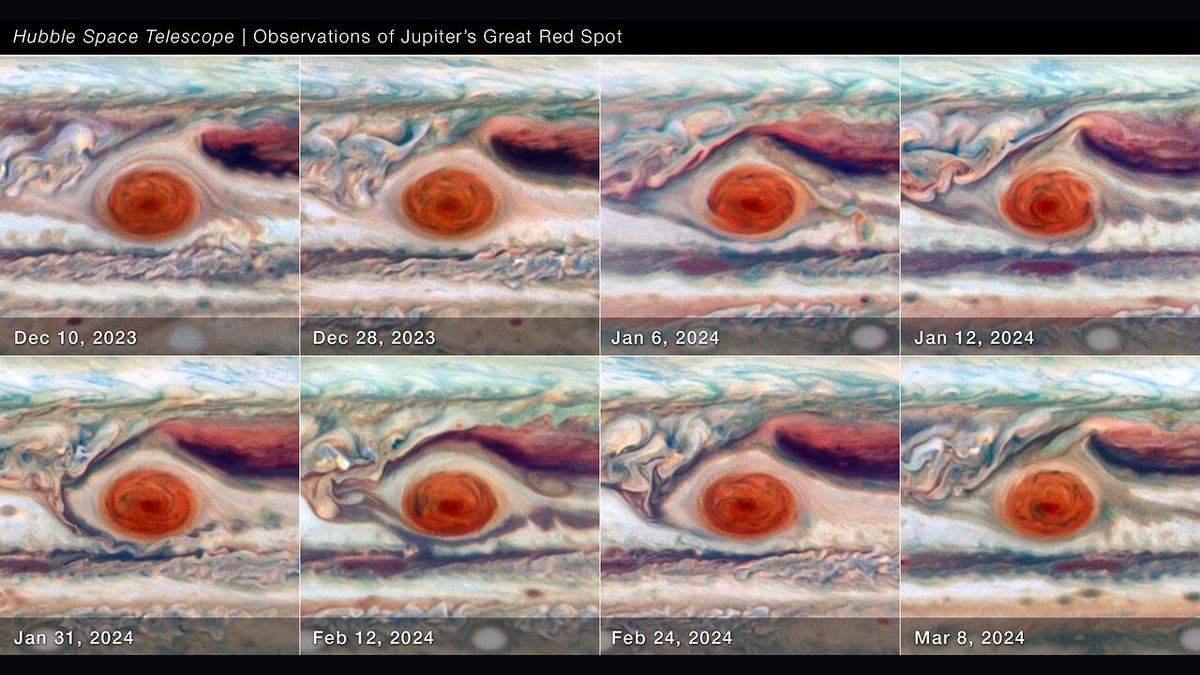
NASA calls the Great Red Spot a giant storm bigger than Earth that has raged for hundreds of years.[1] Jupiter itself is about 11 times wider than Earth, spins once every 9.9 hours (the shortest day in the solar system), and has no solid surface to slow storms down.[1] Britannica says the spot's rotation is counterclockwise, with winds at its edges around 400 kilometers per hour.[4] Its history is long: a 1831 drawing by Samuel Heinrich Schwabe records its position, continuous observation began in 1878, and it may be the same storm that Giovanni Cassini saw in 1665.[4]
Shrinking and changing
NASA's 2014 report tracked the long axis of the spot from about 25,500 miles in the late 1800s to 14,500 miles during the 1979 Voyager flybys, 13,020 miles in 1995, 11,130 miles in 2009 and 10,250 miles in 2014.[2] The shrinking sped up from 2012, at about 580 miles per year, and the shape became rounder.[2] Amy Simon of NASA Goddard noted that "very small eddies are feeding into the storm," which might alter its internal dynamics.[2] Sky and Telescope reported in 2023 that it measured about 12,500 kilometers across, smaller than Earth's 12,756 kilometers, perhaps the smallest size in observational history.[3] Its color also changes; Britannica says it varies from salmon-red to gray, and the cause is not firmly known. Theories include sulfur or phosphorus compounds or organic material.[4]
Deeper than expected
NASA's Jupiter facts page now says Juno data constrain the storm's depth to approximately 300 miles below the cloud tops.[1] NPR's report on the Juno spacecraft's 2019 flybys says the depth is at least 200 to 300 miles, thicker than anticipated.[5] Sky and Telescope gives the roots as about 500 kilometers below the cloud base.[3] Juno's principal investigator Scott Bolton said the question of how the storm lasts so long "is a mystery."[5]
- One idea compares it to a gigantic hurricane powered by condensation of water, ammonia or both.[4]
- Another suggests it draws energy from smaller eddies and nearby currents.[4]
- Britannica notes that no definitive explanation for its longevity exists.[4]
So the Red Spot is both a landmark and an open question, still being measured by spacecraft and telescopes.
Shorter, but taller
NASA reports that research published in the Astronomical Journal found the storm stretching vertically as its area declines, behaving like clay on a potter's wheel, while it has also drifted west faster and deepened to an intense orange since 2014.[7] NASA's account of the Juno results, published in Science in October 2021, puts the depth at roughly 300 miles (500 kilometers) below the cloud tops, deeper than scientists had expected.[6]
Sources7tap to view
- NASA Science. Jupiter Facts. September 21, 2026. Accessed October 5, 2026.
- NASA Science. Jupiter's Great Red Spot Is Shrinking (2014 report). May 14, 2014. Accessed October 5, 2026.
- Sky & Telescope. Jupiter's Great Red Spot just keeps getting smaller. Accessed October 5, 2026.
- Encyclopaedia Britannica. Great Red Spot. Accessed October 5, 2026.
- NPR. In Jupiter's swirling Great Red Spot, NASA spacecraft finds hidden depths. Accessed October 5, 2026.
- NASA. Jupiter's Great Red Spot: Both Deep and Wide. December 8, 2021. Accessed October 5, 2026.
- NASA Science. Jupiter's Great Red Spot Getting Taller as it Shrinks, NASA Team Finds. March 13, 2018; updated October 4, 2023. Accessed October 5, 2026.
Sources disagree on size and details. NASA's facts page says the spot is twice as wide as Earth, Britannica gives about 16,350 km wide, and Sky and Telescope (Nov 2023) gives about 12,500 km, smaller than Earth. Wind speeds are about 400 km/h at the edges (Britannica) versus 430-680 km/h (Sky and Telescope). Depth estimates range from over 200 miles to about 500 km. Differences likely reflect measurement date and definition.