Why Pluto Isn't a Planet, and Why People Still Argue About It
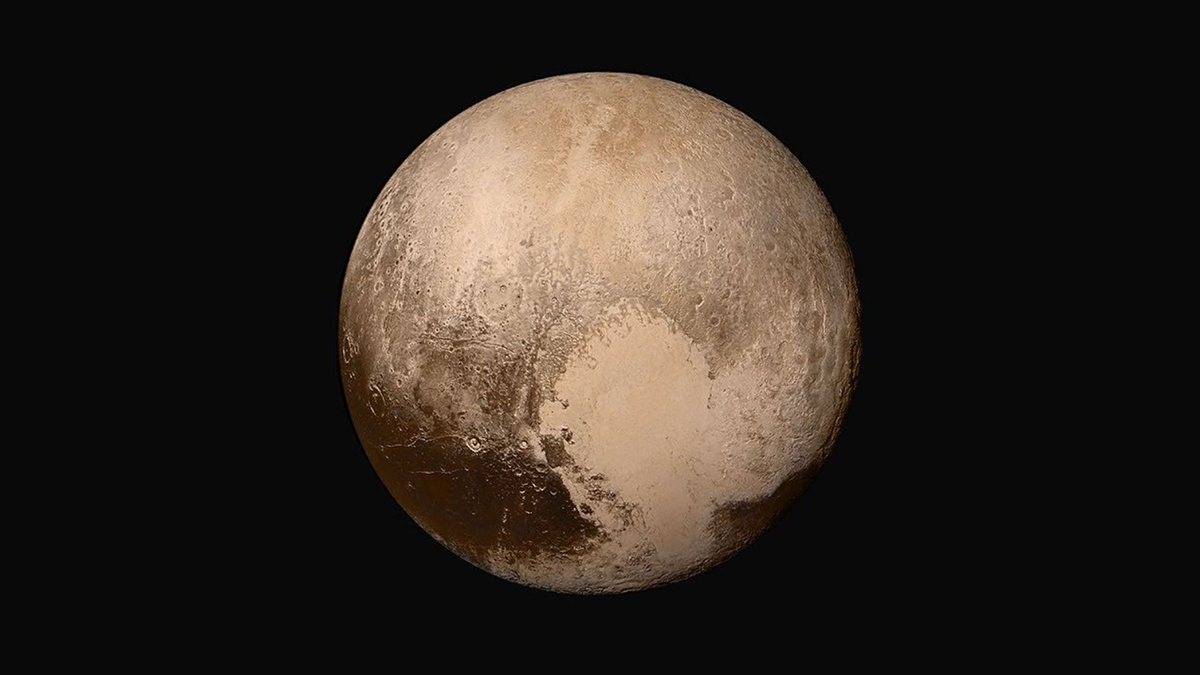
- The IAU adopted a three-part definition of "planet" at its 2006 General Assembly in Prague.
- Pluto orbits the Sun and is nearly round, but has not cleared the neighbourhood around its orbit.
- It is classified as a dwarf planet and lies in the Kuiper Belt beyond Neptune.
For decades Pluto was counted as the ninth planet. In 2006, at its General Assembly in Prague, the International Astronomical Union (IAU) voted on an official definition of the word, and Pluto was reclassified as a dwarf planet.[1][2]
The IAU definition
Under IAU Resolution 5A, a planet is a celestial body that:[1]
- is in orbit around the Sun;
- has sufficient mass for its self-gravity to overcome rigid body forces, so that it assumes a hydrostatic equilibrium (nearly round) shape; and
- has cleared the neighbourhood around its orbit.
Where Pluto falls short
Pluto satisfies the first two criteria but not the third. A dwarf planet is defined by the IAU as a body that meets the first two conditions, has not cleared the neighbourhood around its orbit, and is not a satellite.[1] NASA describes Pluto as a dwarf planet in the Kuiper Belt, a distant region beyond Neptune.[2]
One of five recognized dwarf planets
NASA lists the recognized dwarf planets, in order of distance from the Sun, as Ceres, Pluto, Haumea, Makemake and Eris, and notes that the IAU says there may be many more, perhaps more than a hundred, waiting to be discovered.[3]
What is known about Pluto
NASA's New Horizons became the first spacecraft to explore Pluto up close when it flew past in July 2015.[2] Pluto's largest moon, Charon, is about half its size, the largest moon relative to its parent body in the solar system.[2]
Why the debate continues
The 2006 decision was a vote of the astronomers present at the Assembly and has been criticized by some planetary scientists, who argue that the "cleared the neighbourhood" criterion is difficult to apply consistently. The IAU definition nevertheless remains the official one.
The IAU's own explainer states that Pluto falls into the dwarf planet category because it resides in the trans-Neptunian region, a zone containing other objects that might cross its orbital path.[4] NASA's summary of the definition lists the same three requirements in plain language and names Eris, Ceres, Pluto, Haumea and Makemake as the dwarf planets the IAU recognizes.[5] NASA also reports that Pluto has five known moons: Charon, Styx, Nix, Kerberos and Hydra, and that New Horizons made its flyby on July 13, 2015.[2]
Sources5tap to view
- International Astronomical Union. IAU 2006 General Assembly: Resolutions 5A and 6A (planet and dwarf planet definitions), Prague. 2006. Accessed October 5, 2026.
- NASA Science. Pluto: Facts. September 28, 2026. Accessed October 5, 2026.
- NASA Science. Pluto & Dwarf Planets. Updated September 21, 2026. Accessed October 5, 2026.
- International Astronomical Union. Pluto and the Developing Landscape of Our Solar System. Accessed October 5, 2026.
- NASA Science. What Is a Planet?. Updated September 30, 2026. Accessed October 5, 2026.
The statement about continuing scientific disagreement is background commentary and is not drawn from the sources listed.