Why Mars Is Red: Rust Dust, and a New Twist on Which Rust
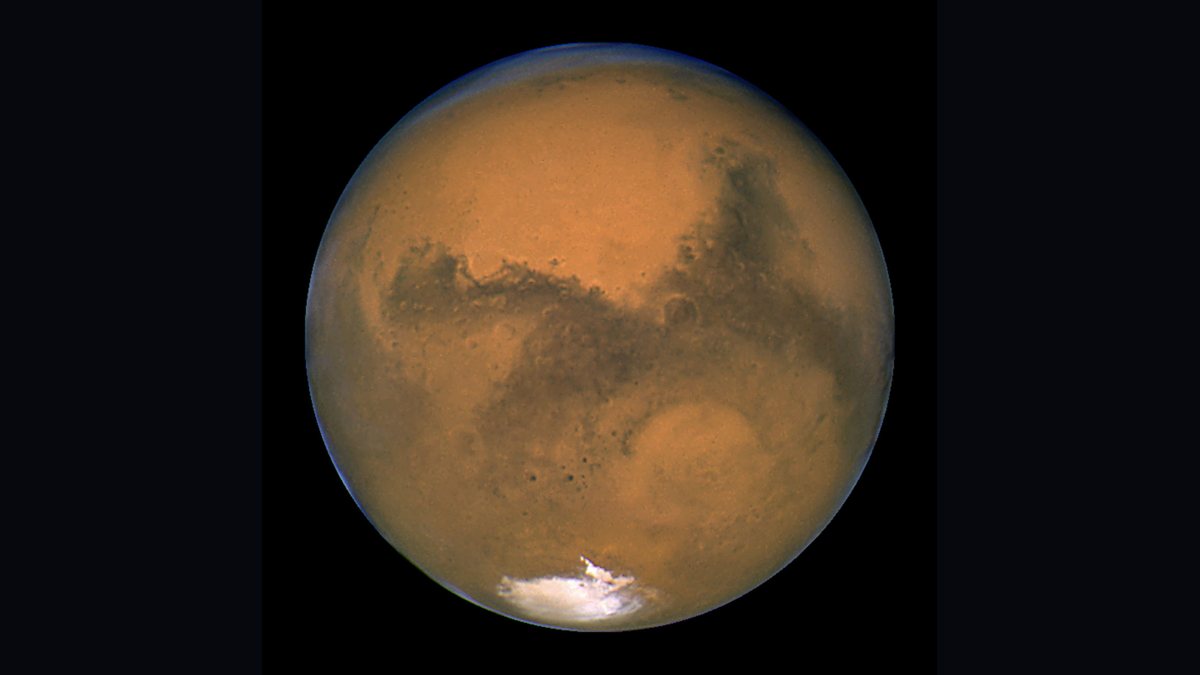
- Rusting iron minerals in Martian dirt and dust give the planet its red look.
- A 2025 study points to ferrihydrite, not hematite, as the main red mineral in the dust.
- Sample return from Mars is still needed to confirm the result.
Rust on a planetary scale
The short answer is rust. NASA states that iron minerals in the Martian dirt oxidize, or rust, and that this makes the surface look red.[1] The color does not stay on the ground. Winds lift the fine dust into the atmosphere, and from a distance it makes the planet appear mostly red.[1] That is why Mars shows up in the night sky as a bright red point of light.[5]
Iron is no rarity on the planet. NASA says Mars has a dense core, 1,500 to 2,100 kilometers in radius, made of iron, nickel and sulfur, inside a world about half the size of Earth.[1] The red coloring, however, belongs to the surface materials, which are exposed to a thin atmosphere of carbon dioxide, nitrogen and argon and to temperatures that range from about 20 degrees Celsius down to about minus 153.[1]
Dust storms spread the effect around. NASA notes that Martian winds are sometimes strong enough to raise storms covering much of the planet, and that it can take months for all of the dust to settle afterward.[1]
Which rust? A newer answer
For a long time, the favored culprit was hematite, a dry, rust-like mineral that forms under warmer, drier conditions. A 2025 paper in Nature Communications challenged that idea. Its authors reported that poorly crystalline ferrihydrite is the dominant iron oxide phase in Martian dust and matches the planet's ochre color best in spectral data.[2]
Ferrihydrite is a water-rich iron oxide that forms in cool, wet environments.[3] According to the paper, the dust grains are smaller than a micrometer and contain roughly 20 to 33 percent ferrihydrite by weight, mixed with basalt and sulfates.[2]
The team, from Brown University and the University of Bern, combined observations from orbiters (NASA's Mars Reconnaissance Orbiter, ESA's Mars Express and Trace Gas Orbiter), measurements from rovers, and laboratory experiments with simulated dust at submicron sizes.[3] Lead researcher Adomas Valantinas said that others had considered ferrihydrite before, but that it had "never been proven the way we proved it now."[3]
What the color says about the past
The mineral matters because of how it forms. The study argues that ferrihydrite records a cold, wet period on early Mars under oxidative conditions, before the planet shifted to the hyper-arid state seen today.[2] Researchers quoted by SETI also pointed to canyons and clays as evidence that liquid water was once abundant.[4]
The result is not final. Direct confirmation would require Martian samples brought back to Earth for analysis.[4] One press account says the answer awaits the return of samples now being collected by NASA's Perseverance rover.[3] Until then, the safe summary is that rusting iron makes Mars red, while the exact mineral remains under debate.
Sources5tap to view
- NASA Science. Mars Facts. 2026-07-10. Accessed October 5, 2026.
- Nature Communications. Detection of ferrihydrite in Martian red dust records ancient cold and wet conditions on Mars. 2025-02-25. Accessed October 5, 2026.
- ScienceDaily. Why is Mars red? Research on Martian dust and ferrihydrite (Brown University and University of Bern). 2025-02-25. Accessed October 5, 2026.
- SETI Institute. Why Mars is red: new study suggests answer. Accessed October 5, 2026.
- NASA Science. Mars. 2026-09-28. Accessed October 5, 2026.
NASA's general Mars page attributes the color to rusting iron minerals without naming one; the 2025 study says ferrihydrite rather than the long-favored hematite. The study describes early Mars as cold and wet, while NASA's Mars page describes it as much wetter and warmer; the sources are not in direct conflict but frame the early climate differently. The ferrihydrite finding awaits sample-return confirmation.