What Is a Black Hole?
- A black hole is not a hole or a cosmic vacuum cleaner; from a distance its gravity matches that of any object of the same mass.
- Stellar-mass black holes form when massive stars collapse; supermassive ones sit at the centers of large galaxies.
- The Milky Way's central black hole, Sagittarius A*, holds about 4 million solar masses.
Matter packed into a small space
NASA describes black holes as huge amounts of matter packed into very small spaces, and notes that they are not really holes.[1] A black hole emits and reflects no light, so telescopes cannot see it directly. Astronomers detect black holes through their effects on surrounding matter, on light and on gravitational waves.[1]
Black holes are also not cosmic vacuum cleaners or wormholes. From a distance, the gravity of a black hole matches that of any other object with the same mass. A black hole with the Sun's mass would leave the planets in their orbits, although the solar system would grow much colder.[1]
The event horizon
The event horizon is the boundary around a black hole inside which escape would require faster-than-light speed, so nothing, not even light, gets out.[1][3] It is a boundary rather than a physical surface, and it encloses all of the black hole's matter.[1] At the center, general relativity predicts a singularity, a point of infinite density. Scientists do not know whether the singularity is a physical structure or a mathematical one, and it may mark where relativity breaks down.[3]
How black holes are seen
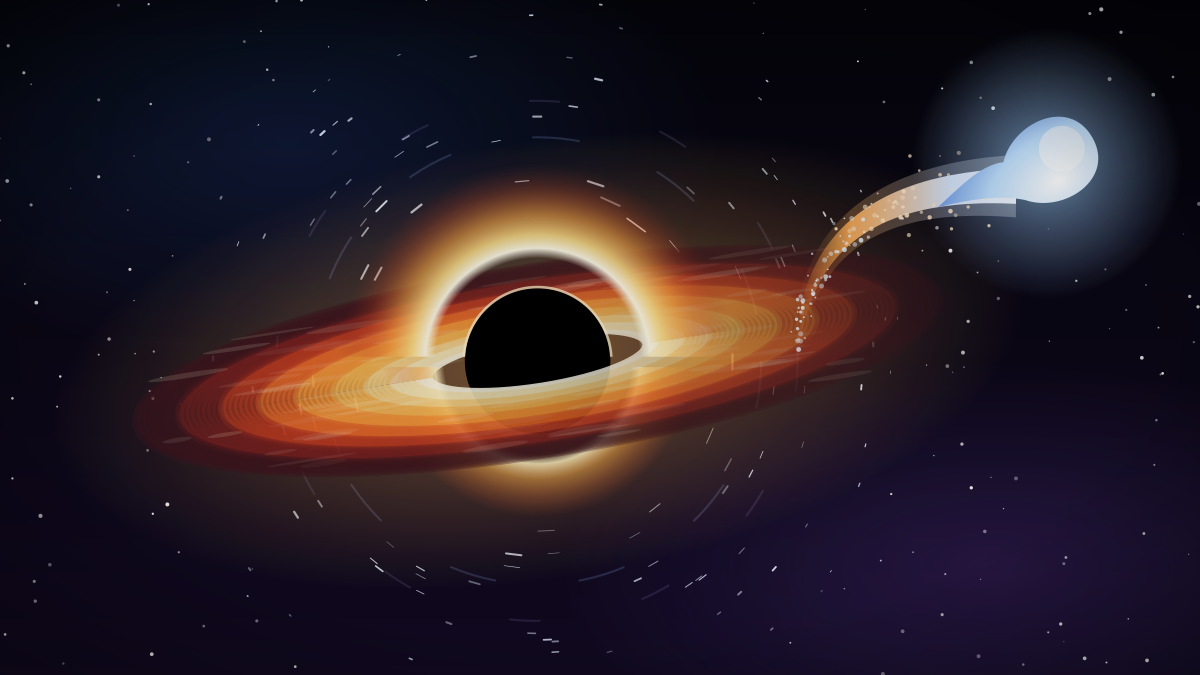
The main light source near a black hole is the accretion disk, a hot, bright, fast-spinning disk of gas that spirals toward the event horizon from a companion star or nearby stars. Isolated black holes without such a disk are hard to find.[3] Thin rings of light at the edge of the black hole's shadow, produced by light that orbits the hole several times before reaching a telescope, are called the photon ring. Jets from supermassive black holes can extend hundreds of thousands of light-years.[3]
Types of black holes
- Stellar-mass: formed when a star of roughly 20 or more times the Sun's mass collapses after a supernova, with masses from a few to hundreds of solar masses. About 50 suspected or confirmed ones are known in the Milky Way, though there may be as many as 100 million in the galaxy.[2]
- Supermassive: found at the center of almost every large galaxy, with masses from hundreds of thousands to billions of solar masses. Their origins are unclear.[2]
- Intermediate-mass: expected to span roughly 100 to hundreds of thousands of solar masses, but hard to confirm. One candidate has about 50,000 solar masses.[2]
- Primordial (hypothetical): theorized to have formed in the first second after the Big Bang, with no definitive proof yet.[2]
The boundaries between categories are not sharp. NASA notes that some scientists place the lower limit for supermassive black holes at tens of thousands of solar masses rather than hundreds of thousands.[2]
Record holders and the Milky Way's black hole
The closest known black hole is Gaia BH1, about 1,500 light-years away. NASA's list gives the most distant as the black hole at the center of the quasar QSO J0313-1806, about 13 billion light-years away, but a growing black hole in the galaxy UHZ1, 13.2 billion light-years away and seen 470 million years after the Big Bang, is the most distant yet seen in X-rays.[4] The most massive on NASA's list is TON 618, at about 66 billion solar masses, while the lightest is about 3.8 solar masses, in a pair with a star. GRS 1915+105 spins over 1,000 times per second.[1] Another supermassive black hole, in Holmberg 15A, holds at least 40 billion solar masses.[2]
Sagittarius A*, the supermassive black hole at the center of the Milky Way, has about 4 million times the Sun's mass. Astronomers confirmed it by tracking stars orbiting near the galactic center, work recognized with the 2020 Nobel Prize. The James Webb Space Telescope has detected bright flares and fainter flickers from it, and the flickers must originate very close to the black hole.[1]
What happens near one
Spaghettification is the name for matter being stretched vertically and squeezed horizontally near a black hole.[1] The corona around a black hole reaches about a billion degrees, and particles in the corona and jets move at speeds approaching the speed of light.[3] The shadow seen from outside is larger than the event horizon itself, roughly twice its size according to NASA.[3]
Formation
One type of black hole forms when a massive star runs out of fuel and explodes as a supernova.[1] Stars of roughly 20 or more solar masses are the ones expected to leave a stellar-mass black hole behind.[2] Nearly all observed stellar-mass black holes are found in pairs with stars, which is also how many are detected through the disk of gas drawn from the companion.[2][3]
Open questions
Several questions remain: how supermassive black holes grew so large, whether intermediate-mass black holes are common, and what the singularity physically is.[2][3] Most Milky Way-sized galaxies appear to have a supermassive black hole at the center, and such objects can launch particles to near light speed.[1]
Sources4tap to view
- NASA Science. Black Holes. 2026-10-07. Accessed October 7, 2026.
- NASA Science. Black Hole Types. 2026-10-07. Accessed October 7, 2026.
- NASA Science. Anatomy of a Black Hole. 2026-10-07. Accessed October 7, 2026.
- NASA. NASA Telescopes Discover Record-Breaking Black Hole. 2023-11-06. Accessed October 8, 2026.
All three sources are NASA pages. The minimum mass of a supermassive black hole is given as hundreds of thousands of solar masses by one page, with a note that some scientists use tens of thousands. Record values (closest, most massive) are as listed by NASA and can change as new objects are found. The pages show no publication date, so the retrieval date is given.